

Why “Winning” a War You Can’t Control Is How Empires Actually Fall
The Athenians annihilated Melos in an afternoon of pure calculation. Within a year, they had destroyed themselves at Syracuse.

On February 26, 2022, a group of finance ministers and central bankers made a decision that had never been executed at this scale in the history of the modern financial system. With a coordinated set of announcements, the United States, the European Union, and their allies froze roughly $300 billion in Russian central bank reserves — money sitting in custodial accounts in Brussels, Paris, London, and New York. It was not a loan called in. It was not a debt collected. It was a sovereign nation’s savings, rendered inert by the stroke of a pen, because the powers holding it had decided they could.
The move was framed, correctly, as a response to invasion. It worked, in the narrow sense: it hurt. It signaled resolve. It gave policymakers in Washington and Brussels a headline victory in a week that badly needed one.
But something else happened in that same afternoon, quieter and slower, the way structural damage always is. Central banks in Beijing, Riyadh, New Delhi, and a dozen other capitals watched reserves they believed were protected by rule of law get seized by political will instead. They did not need a memo to understand the lesson: the system’s neutrality was a courtesy, not a guarantee. Within two years, central banks were buying gold at the fastest pace in over half a century. Alternative settlement systems that had languished for a decade suddenly found funding and urgency. The dollar’s dominance was not challenged by an enemy’s army. It was challenged by the demonstrated willingness of its custodians to use it as a weapon.
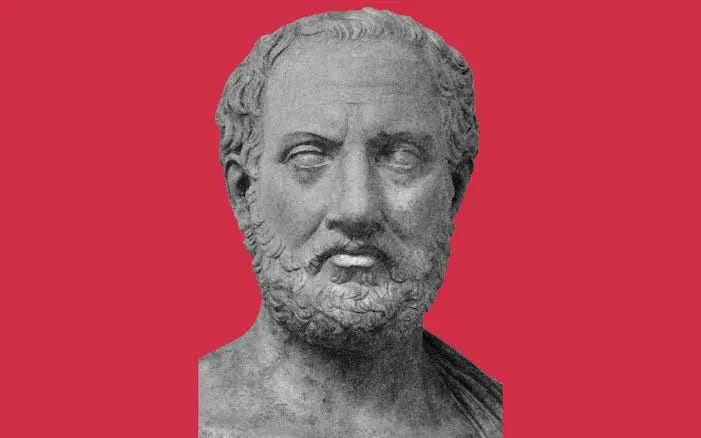
This is a very old story. A historian in exile wrote it down twenty-four centuries ago, and he was not writing about finance. He was writing about an island called Melos.
The Argument That Needed No Justice
In 416 BCE, during a lull in the long war between Athens and Sparta, an Athenian fleet arrived at the small, neutral island of Melos and demanded submission. The Melians tried to argue on the grounds of fairness, of neutrality, of the gods’ regard for justice. The Athenian envoys, as Thucydides records them, dispensed with all of it in a single sentence that has outlived every empire that ignored it:
“The strong do what they can and the weak suffer what they must.”
There was no appeal to right. There was no claim that Athens deserved Melos, or that Melos had wronged anyone. The Athenians simply informed their victims that questions of justice only arise between equals in power — and that between unequals, the only relevant fact is capability. Melos refused to submit. Athens besieged the island, executed the men of military age, and sold the women and children into slavery.
By any conventional measure of the time, this was a triumph. A small threat was eliminated, cheaply, without meaningful cost to Athenian arms. It was, in the coldest sense, a win.
Thucydides does not tell us this was Athens’s mistake. He shows us, one chapter later, that it was Athens’s rehearsal.

The Sequel Nobody in Athens Saw Coming
The very next narrative movement in Thucydides’s history — placed with what can only be deliberate irony — is the Sicilian Expedition. In 415 BCE, barely a year after Melos, the Athenian assembly voted to send its largest fleet ever raised across the sea to conquer Sicily, a target that had never attacked Athens, on the strength of arguments about opportunity, destiny, and the fact that Athens could. The debate in the assembly, as Thucydides records it, was won not by the cautious general Nicias, who warned of the war’s unknowable scale, but by Alcibiades, who spoke the language of appetite: expansion as a law of nature, restraint as a form of decay.
The expedition ended in complete catastrophe. The Athenian fleet was destroyed in the harbor at Syracuse. The army, retreating overland, was slaughtered or enslaved almost to the last man. Athens never recovered the manpower, the treasury, or the confidence it lost in Sicily. It would fight on for another decade, but the war — and eventually the empire itself — was already, structurally, over.
Here is the mechanism Thucydides is asking us to see, and it is the whole of his warning: the logic that let Athens crush Melos without deliberation was the same logic that let it invade Sicily without proportion. Once a polity decides that questions of justice, restraint, and consequence are irrelevant to the powerful, it cannot selectively reapply restraint when the stakes turn against its own interest. The muscle atrophies. You cannot out-argue Alcibiades with Nicias’s caution once the assembly has already agreed, at Melos, that arguments don’t matter — only power does.
Winning the argument at Melos disarmed Athens’s capacity to lose the argument at Sicily.
The Same Two-Step, Four Centuries Later — and Twenty-Four Centuries Later
This is precisely the two-step visible in the modern reserve freeze, and it is visible again in the technology conflict unfolding alongside it. Export controls on advanced semiconductors, imposed to slow a rival’s military and industrial capacity, have “worked” in the tactical sense: they have degraded access to the most advanced chips. And they have also done something else, something the tactical victory obscures — they have accelerated, by every available metric, the target’s determination to build an entirely independent supply chain, immune to future leverage. Coercion that succeeds in the moment often manufactures the very independence it was designed to prevent.
This is not a partisan observation, and it does not belong to one government or one decade. It is the structural signature of any power — a state, a platform, a corporation, an institution — that discovers it can win an engagement through raw capability and stops asking whether winning that way spends something it cannot get back. The instrument that wins the battle is frequently the same instrument that dismantles the system the battle was fought to preserve. Sanctions regimes that erode trust in the reserve currency. Content moderation regimes that “win” the platform’s short-term stability while hollowing out the public’s trust in any shared information space. Surveillance architectures that win the security argument while teaching entire populations that privacy was always conditional. In every case, the tactical win is real. The strategic bill arrives later, itemized in ways nobody predicted at the moment of victory.
Why This Pattern Cannot Be Legislated Away
The reason this keeps recurring is not stupidity, and it is not evil. It is something closer to a law of psychology that Thucydides diagnosed with startling precision: power, once it succeeds without needing to persuade anyone, stops calibrating itself against reality and starts calibrating itself against its own myth.
Thucydides has a word for the fuel of this process — elpis, hope, specifically hope divorced from calculation, hope that behaves as if the last success guarantees the next one. He writes of the Athenians before Sicily that they were “in love with the enterprise” — not reasoning toward it, but desiring it, the way a gambler desires the next hand after a streak of wins. Melos taught the Athenian assembly that resistance to Athenian will was met with total, uncontested success. That lesson did not stay contained to small islands. It generalized. It became the operating assumption under which Sicily was voted into existence.
This is the structural weakness no institution has ever engineered its way around: victories achieved without the friction of genuine deliberation teach the victor nothing except that deliberation was unnecessary. The very mechanism that might have caught the coming overreach — debate, dissent, the caution of a Nicias — has already been discredited by the previous, uncontested win. Power that never has to answer to argument forgets how to recognize when argument is exactly what it needs.
What Is Actually at Stake
The danger here is not that any single empire falls, though empires do fall this way — Athens, certainly, and one could trace the same architecture in Rome’s overextension, in the terminal decades of European colonial administration, in any system that mistook the absence of resistance for the presence of legitimacy. The deeper danger is that the tools available to any dominant power today — financial, technological, informational — make this ancient trap easier to walk into and harder to notice, because the feedback loops are longer and the early wins feel cleaner than they ever did on a Greek battlefield.
A siege takes visible casualties. A reserve freeze, a chip embargo, an algorithmic ban — these register first as data on a dashboard, not as blood. The cost is real, but it is deferred, diffused, and denominated in a currency — trust, legitimacy, the willingness of others to remain inside your system voluntarily — that does not show up on a quarterly report. By the time the deferred cost comes due, the people who made the original decision are gone, and the people inheriting the bill rarely know which decade’s “win” they are actually paying for.
That is the real stake: not defeat in a single confrontation, but the slow, invisible transfer of the future’s options into the past’s appetite for an easy victory.
What the Historian Left for Us to Notice
Thucydides did not write his history to entertain the Athenians of his day, and he said so directly — he called it ktema es aei, “a possession for all time,” meant to be useful precisely because human nature does not change even as its instruments do. He was exiled by the very city whose ruin he chronicled, which may be why he wrote without needing anyone’s permission to tell the truth.
The thinking citizen’s task is not to root against power, or to pretend that restraint always wins. It is to ask, before the applause for any decisive victory fades, a single unglamorous question: what did this win teach the winner to expect from the next one? If the answer is that resistance is always futile, that argument is always irrelevant, that the strong will always simply do what they can — then the Sicilian Expedition, in whatever modern form it takes, is already being drafted, and the vote to approve it has probably already been taken in a room where nobody thought to invite a Nicias.
The Melians lost their island in an afternoon. What Athens lost afterward took longer, cost more, and could never be frozen back.