

Three Questions on Work, Control, and the Meaning of Freedom in the Age of RTO
Marcuse’s Warning About One-Dimensional Life Is Playing Out in Every Commute

The elevator doors open onto the 12th floor at 8:47 AM on a Tuesday in late October. The carpet is a shade of gray that seems designed to absorb hope. The air conditioning hums at a frequency that neuroscientists have linked to mild depression. A woman named Sarah—mid-level manager at a Fortune 500 consulting firm—swipes her badge. The scanner beeps. The green light flashes. She has been recorded.
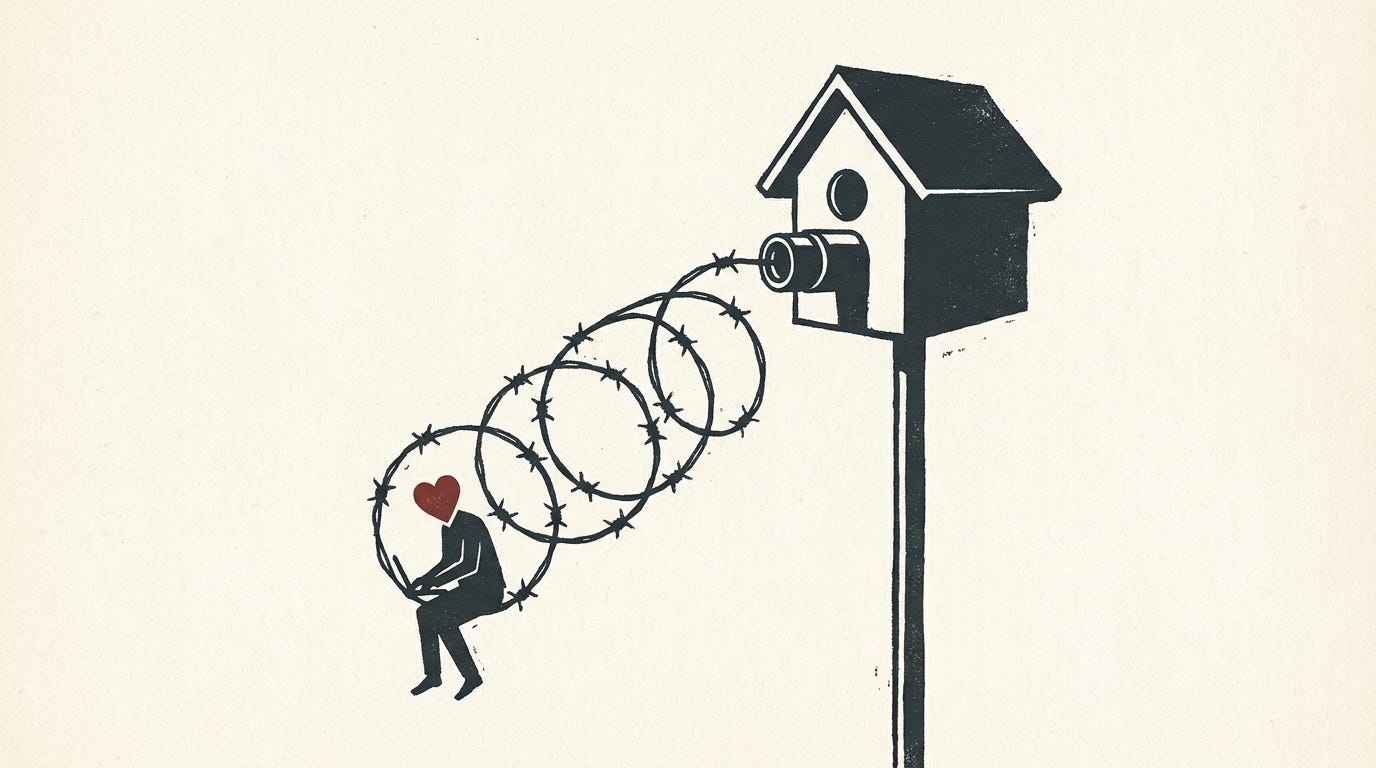
Sarah worked from home for eighteen months during the pandemic. She was more productive. Her team was more productive. The quarterly reports showed it. But the CEO, in a memo titled “Our Culture Needs You Here,” announced that all employees must return to the office three days a week. No exceptions. The rationale: “spontaneous collaboration.” The reality: Sarah’s calendar is now wall-to-wall Zoom calls, exactly as it was at home, except now she does them in a cubicle with noise-canceling headphones. The spontaneous collaboration never materializes. Her colleagues sit in silence, each on their own screen, waiting for the clock to reach 5:00 PM so they can sit in traffic for another hour.
She stares at the wall. The wall stares back. She has no vocabulary for the feeling that sits in her chest—a low, thrumming fog of resentment and resignation—because the language available to her is the language of the system that put her here. “Compliance.” “Company culture.” “Career growth.” Nothing in that vocabulary names the absurdity of what she is doing. Nothing in that vocabulary asks the first question.
The question she cannot bring herself to form is the only one that matters: Why am I doing this?
The Philosopher Who Saw the Coming Flatness
Herbert Marcuse published One-Dimensional Man in 1964, at the height of the postwar industrial juggernaut. The book is often misread as a Marxist screed against capitalism, which misses the point. Marcuse was diagnosing something more subtle and more terrifying: the collapse of the human capacity to imagine alternatives to the existing order.
He called it “one-dimensional thought.” In a society dominated by technological rationality—where efficiency, productivity, and measurable output become the only criteria for what counts as true or good—the mind itself is flattened. Critical thinking, which depends on the ability to stand outside the system and judge it, becomes impossible because the system has colonized all mental space. Every problem is reframed as a technical problem. Every desire is shaped by the available commodities. Every form of resistance is absorbed and neutralized.
Marcuse’s warning was not about some distant totalitarian future. It was about the present he saw emerging: a society in which people are “satisfied” with their unfreedom because the system provides enough comfort, enough distraction, enough of what he called “false needs” to keep them docile. The greatest danger, he wrote, is not that people will be forced into slavery, but that they will freely choose a life they do not recognize as unfree.
The office tower Sarah sits in is a monument to this warning. The badge scanner is not a tool of security. It is a tool of one-dimensionalization. Every swipe is a micro-ritual that says: You are here because we say so. You have no other option. This is the only world.
Why the Commute Is Not About Collaboration
Let us state what everyone knows but few will say aloud: the return-to-office mandates sweeping corporate America have nothing to do with productivity. Study after study—Stanford, MIT, the National Bureau of Economic Research—has found that remote work either maintains or increases output. The CEOs who claim otherwise are either lying or operating on anecdotal evidence that would be laughed out of a freshman statistics course.
So why are they doing it? The standard answer is “control.” This is true but insufficient. It does not explain why control matters more than profit. Marcuse offers a deeper answer: the system must reproduce the conditions of its own continuation, and one of those conditions is the physical presence of bodies in designated spaces. The office is not a place of work. It is a place of symbolic obedience. The commute, the badge scan, the fluorescent lights, the open-plan layout that destroys privacy and concentration—these are not regrettable side effects. They are the point.
Consider what the remote worker threatened. In their home, they had a sliver of autonomy. They could structure their day around their actual rhythms. They could see their children between meetings. They could pause to think without the surveillance of a manager’s glance. This autonomy was not full freedom—they were still working, still producing value for the company—but it was a wedge. And a wedge is the most dangerous thing to a one-dimensional system, because a wedge is the beginning of two-dimensional thought. Once you experience a crack in the system, you begin to ask: what else might be possible?
The RTO mandate is the system rushing to seal that crack. It is Marcuse’s “desublimation” in action: the process by which a potentially liberating force is re-channeled into the existing order. Remote work was a promise of liberation. The RTO is the cancellation of that promise. And because the cancellation is framed as a necessary sacrifice for “culture” or “innovation,” it becomes difficult to name what has been lost.
The First Question: Why Do We Obey?
Here is the question that Sarah—and millions like her—must ask, but cannot ask, because the vocabulary does not exist: Why do we obey a command that makes no sense?
The obvious answer is economic necessity. People fear losing their jobs. But this does not explain why there is so little collective resistance. Labor markets are still tight in many sectors. Workers have leverage. Yet the resistance is atomized, whispered in Slack channels, never organized. Why?
Marcuse would point to the internalization of authority. In one-dimensional society, external coercion is replaced by self-administered control. You do not need a boss to yell at you. You have an internal voice that says: If I do not comply, I will be seen as difficult. I will be passed over for promotion. I will be the first to be laid off. This voice has been trained into you by years of schooling, performance reviews, career ladders, and the implicit threat of precarity.
The system does not need to force you to obey. It needs only to make disobedience unthinkable.
This is why the RTO debate feels so frustrating. The rational arguments are all on the side of flexibility. The data is clear. The preferences of workers are overwhelming. And yet the decision is made by a handful of executives who do not experience the consequences. The rest comply. Not because they are lazy or cowardly, but because the very structure of their consciousness has been shaped to accept the boss’s authority as natural.
The first question—Why do I obey?—is a revolutionary question. To even ask it is to take a step toward the second dimension. And that is why the system works so hard to prevent you from asking it.
The Second Question: What Is Work For?
Marcuse drew a crucial distinction between “basic repression” (the necessary constraints required for survival, like not hitting people) and “surplus-repression” (the additional constraints imposed by a particular social system to maintain its power structure). Under capitalism, most of what we call “work” is surplus-repression—activity that does not fulfill human needs but instead serves the needs of capital accumulation.
The RTO mandate is a textbook case. The commute does not make Sarah more productive. The open-plan office does not spark innovation. The badge scan does not improve collaboration. All of these are rituals of surplus-repression. They consume time, energy, and attention that could be used for actual living. They are not designed to produce value. They are designed to produce obedience.
But here is the trap: the system has defined “work” so narrowly that any refusal to participate appears as laziness, as irresponsibility. The vocabulary of “productivity” has been captured by the very forces that waste your time. When Sarah’s CEO says “we need to protect our culture,” he is using a word that should mean something rich and human—shared meaning, mutual care, collective purpose—and twisting it to mean “bodies in a room.”
*The second question—What is work for?—forces you to distinguish between necessary activity and surplus-repression, between genuine contribution and performative obedience.* If you cannot make this distinction, you will spend your life serving a system that does not serve you.
The Third Question: What Would Freedom Look Like?
This is the hardest question, because freedom is the concept that one-dimensional society has done the most to destroy. In the vocabulary of the modern workplace, “freedom” means the freedom to choose between two equally meaningless options: work in the office on Tuesday or Thursday? Which flexible arrangement will you select? The system offers you countless choices within its narrow frame—what phone to buy, what career path to pursue, what brand of oat milk to consume—and calls this liberty.
Marcuse called it “repressive desublimation”: the granting of superficial freedoms that leave the deeper structure intact. You can vote, but the options are pre-selected. You can speak, but only in a language shaped by corporate media. You can work from home, but only until the CEO decides otherwise. The appearance of choice masks the absence of genuine alternatives.
Genuine freedom, for Marcuse, would be the ability to say “no” to the entire framework—to refuse the premise that work must define your life, that your time belongs to an employer, that your identity is tied to your output. This is what he called “the Great Refusal.” It is not a one-time act of rebellion. It is a continuous practice of critical thinking, of holding the system at arm’s length, of refusing to let your consciousness be flattened.
The RTO debate is a small theater for this larger struggle. It is not the most important fight. But it is a fight that millions of people are living through right now, and how they respond will shape their capacity to fight the larger battles—over automation, climate change, democratic erosion, inequality. If you cannot resist a mandate that requires you to commute for two hours to sit in a cubicle and take Zoom calls, what will you resist?
The Stakes of Not Asking
Marcuse’s prophecy was not that society would become a nightmare. It was that society would become a comfortable, smooth, reasonable unfreedom—a world in which the absence of true freedom is not felt because the system provides enough distraction, enough consumption, enough minor pleasures to keep you satisfied.
The RTO mandate is a test. Not of your loyalty to your employer, but of your capacity to recognize unfreedom when it offers itself in a business-casual suit. If you cannot name the absurdity of the present, you will have no ability to resist the future. And the future is coming faster than you think. AI will not replace all jobs, but it will accelerate the logic of one-dimensionalization—redefining human worth in terms of measurable, optimizable output. The RTO debates of 2024 are a dress rehearsal for the debates of 2030, when the demand will not be just your presence but your total identity.
The stakes are not about office space. The stakes are about whether you retain the capacity for two-dimensional thought—the ability to stand outside the system and judge it against a standard that the system does not provide. Once that capacity is lost, everything else is lost.
A Posture for the Thinking Citizen: The Practice of Refusal
You will not change the system by refusing to return to the office. The system is vast and indifferent. But you will change yourself. And that, in the end, is where all change begins.
The philosopher’s posture for the age of RTO is not a manifesto or a protest sign. It is the quiet, persistent practice of asking the three questions that the system suppresses:
Why am I obeying?
What is this work really for?
What would genuine freedom look like?
These questions are not rhetorical. They require you to sit with discomfort, to admit that you do not know, to resist the easy answers that the culture offers. They require you to see the badge scanner as what it is: a ritual of submission that you have the power to name. They require you to recognize that the freedom you seek cannot be granted by an employer, a policy, or a political party. It must be reclaimed, every day, in the small acts of refusal that add up to a different way of being human.
Sarah, still staring at the wall on the 12th floor, does not yet have a name for what she feels. But the question is forming. It is a crack. And in a one-dimensional world, a crack is the beginning of everything.
very nice essay....