The Scapegoat in Stilettos: Three Questions on the Modern Witch Trial

Let’s be honest about the public takedowns of famous women. We tell ourselves it’s about accountability, but is it?
I want to ask three uncomfortable questions that reveal a much older, darker social ritual at play—one that has nothing to do with justice.
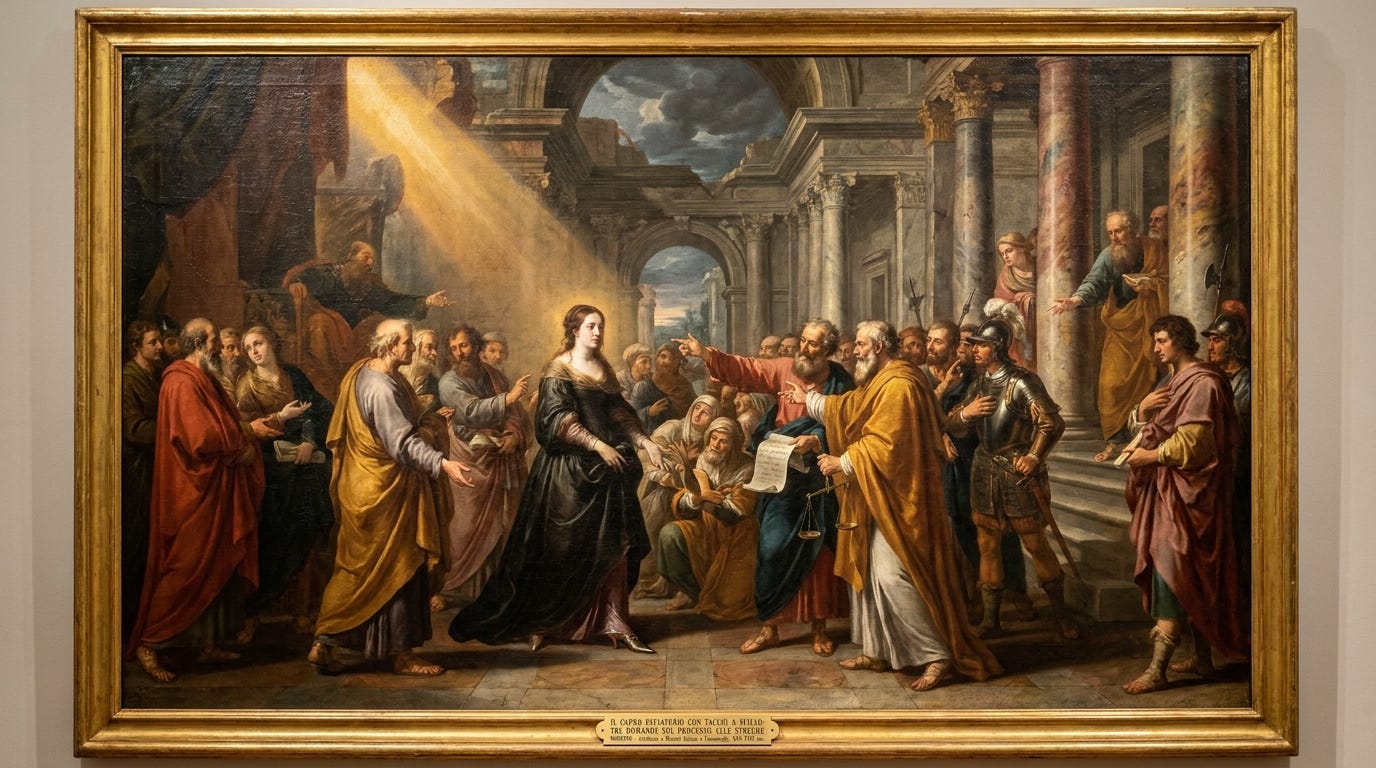
Question One: Why does the punishment never seem to fit the crime?
You’ve seen the pattern. A female influencer or celebrity makes a mistake. Maybe a clumsy old tweet surfaces, a brand deal feels hollow, or a personal moment reveals an ugly crack in the perfect facade. The act itself is often minor, almost laughable compared to the world’s real problems. And yet, the reaction is a biblical flood of rage. A digital mob forms and demands not an apology, but an annihilation. Why?
Here’s the uncomfortable truth: the outrage isn’t about her mistake. Her error is just the starting gun for a race that was already waiting to happen. We don’t get angry because of the transgression; the transgression merely gives us permission to be the kind of angry we already were. Your anxiety about money, my frustration with the phoniness of online life, our collective sense of powerlessness—it all gets channeled into a single, manageable target. As the philosopher René Girard saw, the scapegoat’s actual guilt is secondary. What matters is that we, the community, agree on it. In that shared condemnation, we find a brief, thrilling moment of relief from our own chaos.
Question Two: Why is it so often a woman?
Of course, men get cancelled too. But I want you to notice the specific texture of the rage directed at women. Male scandals are typically about concrete actions: financial crimes, physical abuse, abuse of power. We get angry at what they did. Female scandals, on the other hand, are so often framed as failings of character. She wasn’t just wrong; she was deceptive, vain, inauthentic, a fraud. We get angry at who she is.
This isn’t a coincidence. It’s a script as old as time, a modern retelling of the witch hunt. The female influencer, building her own empire of influence and capital outside the old boys’ club, represents a new kind of power that makes the old order deeply uncomfortable. So, we put her on trial. Not for any specific crime, but for the audacity of her position. By publicly shaming her for her supposed moral failures, the mob gets to put a threatening form of female power back in its box, all under the noble banner of “accountability.”
Question Three: If this isn’t justice, what is it?
So if this ritual isn’t about making the world more just, what are we actually doing? We’re performing a rite of social catharsis. We’re letting off steam. The world’s real problems are huge, complex, and lack a simple villain. You can’t tweet-storm your way into solving economic inequality or political decay. But you can destroy a 28-year-old reality star. You can feel, for a day, like you’ve cleansed the world of something evil.
This process of projection is the core of the machine. This is where the analysis gets more complex—the psychological mechanism underneath this pattern, what Girard called mimetic rivalry, is explored in depth in our paid guide on the anatomy of digital mobs. For now, the key point here is that the goal isn’t reform; it’s ritual sacrifice. It creates a powerful illusion of unity. For a brief moment, we all agree. We are the good people. She is the bad one. Public condemnation has become a consumer good, offering the intoxicating feeling of moral action without the cost of actual conviction. Nothing has changed, of course. The moment passes, the anxiety returns, and the machinery hungrily scans the horizon for the next woman to fall.
The Waiting Machinery
This is the surface of a much deeper pattern. The full mechanism — René Girard’s theory of mimetic desire and why it first creates the very idols we feel compelled to destroy — is the subject of our paid Deep Guide on the architecture of digital scapegoating.
If This Matters to You
The Third Citizen publishes weekly deep dives, frameworks, and evidence digests for readers who take ideas seriously. Free articles like this one are the surface. Paid subscribers get the full architecture — the frameworks, the mechanisms, the uncomfortable implications.
If you’re still reading, you’re probably one of us.