

The Reflecting Pool Is the Message: What McLuhan Knew About the Spectacle of Decay

You are scrolling at 2:14 a.m., phone brightness reduced to a dim ache, and the algorithm serves you a forty-second clip of a man in a suit screaming at another man in a suit about something neither of them will remember next week. Below it, a comment thread of 12,000 people has already split into warring camps, each convinced the other is evil. You are alone in the dark, but you are not alone—everyone else is alone in the dark too, each face illuminated by the same blue glow, each thumb moving in the same compulsive rhythm. This is not a bug. It is not a failure of moderation. It is the medium doing its work, and Marshall McLuhan understood this better than anyone alive today, because he saw the shape of the machine before the machine had fully assembled.
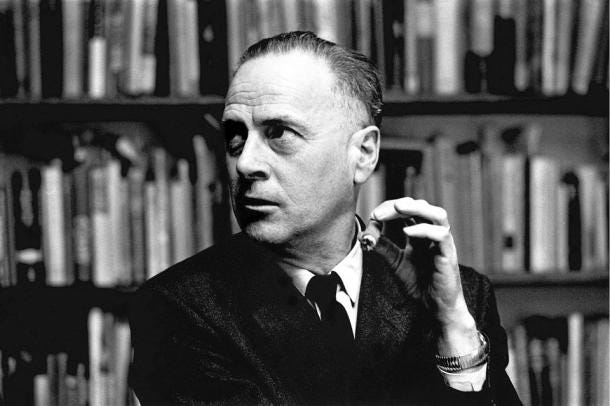
McLuhan died in 1980, before the internet was a household word, before the smartphone, before the platform economy. But he saw the future in the rearview mirror of the television age. His central insight—that the medium is the message—was not a clever aphorism. It was a diagnosis of how technology conditions human consciousness, how the channel of communication matters more than the content it carries. A television set does not just broadcast programs; it reshapes the nervous system of everyone who sits before it. It collapses distance, compresses time, and turns the viewer into a passive receptor of continuous, fragmented stimulation. McLuhan called this “the global village,” but he did not mean it as a compliment. He meant that we would all be pressed into a single, overheated electronic space, tribalized by speed, unable to escape the constant roar of each other’s presence. The village, after all, is a place of gossip, surveillanc
e, and claustrophobia—not a utopia.
Now, four decades after his death, the village has become a mirror maze. Every platform is a reflecting pool that shows you versions of yourself you never asked to see. You do not use social media; social media uses you. The algorithm is not neutral—it is a sculptor of desire. It learns your vulnerabilities, your resentments, your secret boredom, and it feeds you the image that will keep you looking. This is what McLuhan meant when he said that “the content of a medium is always another medium.” The content of the internet is the self, endlessly mediated, reflected back through the distorting glass of engagement metrics, dopamine loops, and outrage economy. You stare into the screen, and the screen stares back, and what you see is not the world but the spectacle of your own attention.
The mapping is precise. Consider the 2016 U.S. presidential election, a case study McLuhan would have recognized instantly. The content of the election was policy, character, history. But the medium—Twitter, cable news, Facebook—was the message. The platform rewards polarization because polarization drives engagement. A candidate does not need to be coherent; he needs to be seen being seen. The spectacle becomes self-justifying. Every outrageous tweet, every manufactured scandal, every carefully staged insult is not a failure of politics but a victory of the medium’s logic. The medium demands that you keep looking, and the only way to keep you looking is to escalate the stimulus. This is why public discourse has become a form of performance art in which the audience is also the performer, and the stage is a digital coliseum where everyone is bleeding for attention and no one can leave.
Look closer. The architecture is deliberate. The infinite scroll is not a feature; it is a conditioning device. The notification badge is not a convenience; it is a Skinner box. The share button is not a tool; it is a amplification circuit. McLuhan wrote that “we shape our tools and thereafter our tools shape us.” We have shaped these tools to maximize the extraction of attention, and they have shaped us into hungry ghosts—perpetually unsatisfied, perpetually consuming, perpetually alone in the crowded room of the global village. The great irony is that the more connected we become, the more isolated we feel. The more we broadcast our lives, the less we live them. The more we participate in the spectacle, the more we become the spectacle.
But why? Why do we fall for this? The mechanism is not conspiracy but structural inevitability. McLuhan understood that media are extensions of human faculties. The wheel extends the foot; the book extends the eye; the television extends the central nervous system. The internet extends the entire sensorium into an artificial environment. But here is the catch: every extension comes with a corresponding amputation. When you extend your senses into the digital environment, you numb the physical one. You stop feeling the weight of the body, the texture of the moment, the presence of other people in real space. The medium demands your full attention, and attention is a finite resource. You cannot pay attention to the algorithm and to your child at the same time. One of them will lose.
The deeper force driving this pattern is the commodification of awareness. In the industrial era, the scarce resource was labor. In the information age, the scarce resource is attention. Every platform is a factory designed to mine it, refine it, and sell it to advertisers, propagandists, and anyone else willing to pay. But attention is not infinite. When you extract it from one place—a conversation, a walk, a book—you deplete it elsewhere. The result is a civilization that is increasingly perceptually undernourished. We are drowning in data and starving for meaning. We see everything and understand nothing. We are connected to millions and intimate with no one.
McLuhan’s tetrad—his framework for analyzing any medium—asks four questions: What does it enhance? What does it obsolesce? What does it retrieve? What does it reverse into when pushed to its extreme? Apply these to social media. It enhances connection over distance. It obsolesces face-to-face presence. It retrieves the tribal dynamics of the pre-literate village. And when pushed to its extreme—when everyone is always on, always broadcasting, always performing—it reverses into a surveillance panopticon where the watchers are also the watched, and privacy becomes a memory. This is not accidental. It is the logic of the medium unfolding in real time.
What are the stakes if we refuse to understand this? They are catastrophic, but not in the way you might imagine. The danger is not that we will be brainwashed by propaganda—though that happens too. The danger is that we will lose the capacity to distinguish the spectacle from reality. When every event is staged for the camera, when every outrage is manufactured for engagement, when every leader is a character in a drama written by the algorithm, the category of the authentic dissolves. Politics becomes performance. Grief becomes content. War becomes a feed. The cost of this epistemic collapse is not just bad policy or bad vibes. It is the inability to act collectively on shared problems, because there is no longer a shared reality to act upon. Climate change becomes a “narrative.” Economic inequality becomes a “framing.” The pandemic becomes a “story.” We are not debating facts; we are consuming genres. And the medium, which profits from division, ensures that the genres never resolve.
McLuhan wrote that “the future of the book is the blurb.” He meant that in an age of electric media, the fragment replaces the whole. The sound bite replaces the speech. The headline replaces the article. The tweet replaces the argument. This is where we are now: a culture of the fragment, unable to hold complexity, addicted to the next stimulus, incapable of sustained attention. The cost of ignorance here is not that we will be tricked by bad actors—though we will—but that we will lose the very muscle of thought itself. The medium does not just carry messages. It conditions the mind. And the mind conditioned by the spectacle of decay becomes a mirror of the spectacle: flickering, shallow, reactive, incapable of depth.

So what does the thinking citizen do with this knowledge? Not a solution—there is no app for this, no platform, no policy that will undo the structural logic of the medium without dismantling the medium itself. A posture. A way of holding oneself in the current.
First: recognize the medium as the message. The content is a distraction. The real story is the interface, the algorithm, the architecture of attention. When you feel that familiar tug of outrage or envy or anxiety, ask yourself: What is this medium doing to me right now? Not what is this post saying—but what is this medium doing. The answer will almost always be: extracting your attention, amplifying your emotion, and narrowing your perception.
Second: starve the spectacle at the margins. You do not need to delete your accounts or go off-grid. But you can starve the algorithm by refusing to feed it your most valuable resource: your reactive attention. Do not comment on outrage. Do not like the bait. Do not scroll through the feed when you are bored. Let it be boring. Let it be empty. The spectacle only works if you watch. If you stop watching, the spectacle collapses into the absurdity it has always been.
Third: cultivate the offline as a discipline of perception. Read long books. Walk without a phone. Sit in a room with another person and do not pick up the device. This is not luddite nostalgia; it is a form of resistance. You are rebuilding the capacity for sustained attention, which is the foundation of all serious thought. McLuhan said that “the electric light is pure information.” But so is the unhurried silence between two people who are truly present. That silence, too, is a medium. And its message is the opposite of the spectacle: it says you are here, you are alive, you are not being watched.
The reflecting pool is the message. And if we cannot look away from our own reflection long enough to see the world outside the glass, then the world outside will continue to rot while we scroll past it, each of us alone in the dark, each of us a mirror reflecting only the flicker of the machine. The choice is not whether to use the medium. The choice is whether to remain its subject—or to become, in the quiet spaces between notifications, something more like a self.