


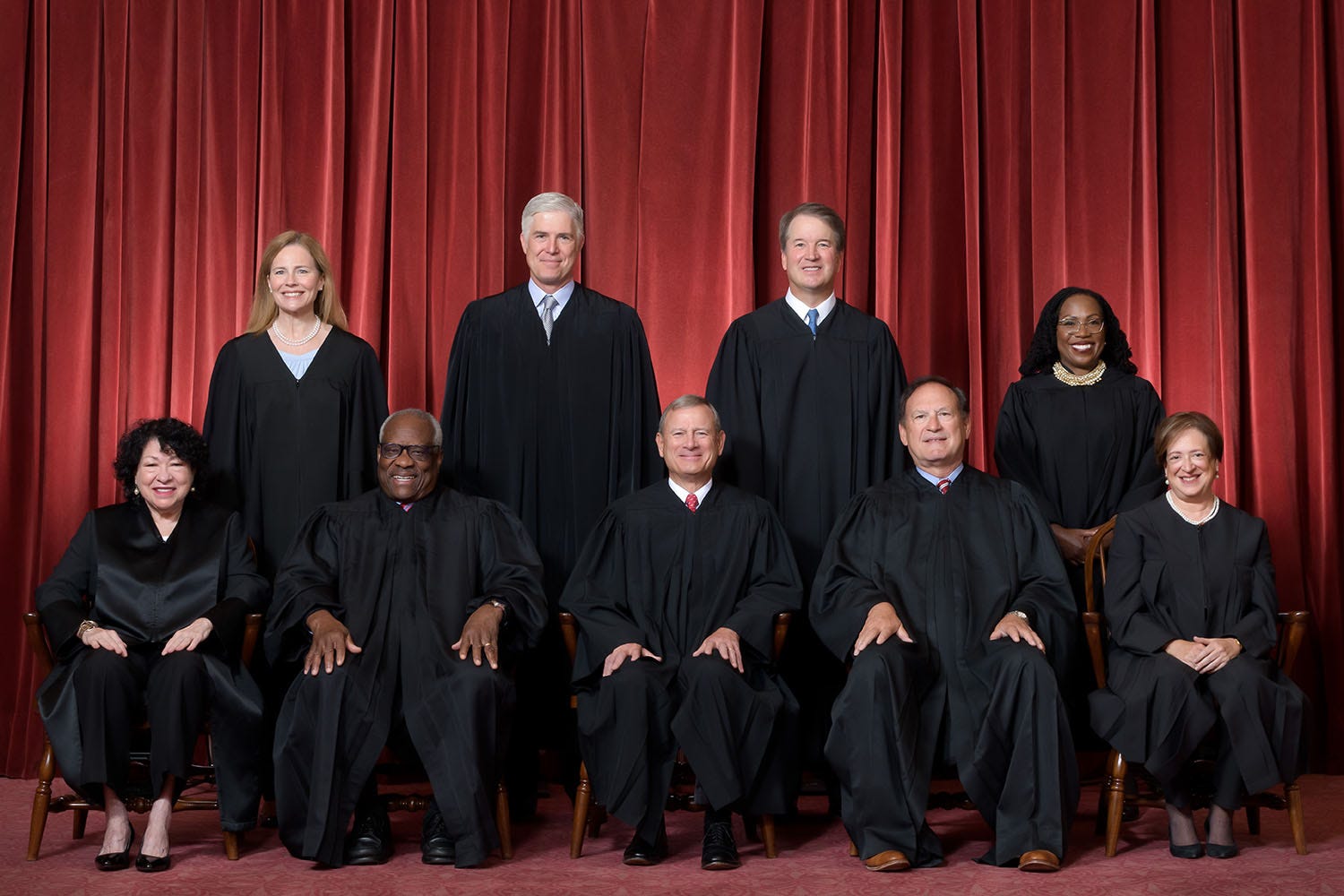
A Decision That Went Unremarked
On the last Tuesday of June, the Supreme Court released a 6–3 opinion in a case that drew little public fanfare. The question before the justices was narrow: whether states had standing to challenge the Biden administration’s immigration enforcement priorities. The Court said no. The headlines the next morning celebrated the result as a procedural win for the executive branch. But beneath the dry legalese, something far more troubling was quietly affirmed. The government’s lawyer had argued that the executive branch retains unreviewable discretion to decide which immigrants to deport, which to leave alone, and which to effectively legalize through inaction. The Court agreed.
This is not a left or right issue. What the Court sanctioned was the idea that the law’s own boundaries can be redrawn by the very institution meant to be bound by them. At the border, in detention centers, and in the offices of U.S. Citizenship and Immigration Services, a question is now permanently unresolved: What does it actually mean for a person to be “lawfully” present in the United States, if the sovereign—the executive—can suspend enforcement against whole categories of people with a memo? The answer, hidden in plain language, comes from a philosopher few in the Court’s chamber had likely read.
The Forgotten Philosopher of the Exception
Giorgio Agamben, born in Rome in 1942, spent decades excavating a hidden thread in Western political thought. He did not write about immigration. He wrote about concentration camps, Roman law, and the theology of sovereignty. But his central insight is the master key to understanding what just happened. Agamben argued that the sovereign is not the one who makes the law—the sovereign is the one who decides the exception to the law. This seems contradictory: How can a system of rules also include the power to break those rules? But that is precisely the structure of sovereignty. The law must be suspended to be applied, because a rule cannot rule itself. Someone must step outside to say “now it does not apply,” and that act of stepping outside is the ultimate demonstration of power.
In plain terms: You cannot have a legal immigration system without someone deciding who is “legal.” But if that decision is entirely discretionary, then “legality” becomes a function of political will rather than statutory text. Agamben called this the “state of exception”—a legal condition that is not law at all, yet is paradoxically the foundation of legal order. The camp, he wrote, is the paradigm of modern politics: a space where the law has been suspended and people are reduced to “bare life,” stripped of legal protection. The Supreme Court’s ruling did not create camps. But it reaffirmed the machinery that makes camps possible: a sovereign that can decide who falls inside and outside the law’s protection.
When the Court Deferred to the Sovereign
The case, United States v. Texas (2023), seemed technical. At issue was a Department of Homeland Security memo that prioritized deportation of certain categories of noncitizens—criminals and national security threats—while deprioritizing others. Texas and Louisiana argued that this memo effectively granted “lawful status” to hundreds of thousands of people by refusing to enforce the law. The administration countered that prosecutorial discretion is inherent in executive power. The Court agreed with the administration, ruling that the states lacked standing to challenge federal enforcement decisions.
Let us be precise about what this means. Under the Immigration and Nationality Act, many noncitizens are classified as “removable.” The law does not say “prosecute at your discretion.” It says they shall be removed. But by declaring that the executive can choose not to enforce against entire categories, the Court effectively ratified the executive’s power to create zones of informal legality—and informal illegality. The CBP One app, which schedules asylum appointments at ports of entry, becomes a digital dispensation. The Title 42 expulsion policy, which since 2020 has blocked asylum at the southern border, was another state of exception dressed in public health language. Each time, the judiciary deferred to the executive’s claim of emergency or discretion.
The pattern is not new. In 2012, the Obama administration created DACA—a program that granted quasi-legal status to young undocumented immigrants—through a memo, not a law. Courts fought it for a decade. But the principle at stake was never about DACA’s merits; it was about whether a president could unilaterally rewrite immigration law. The Supreme Court has now signaled that the executive can, as long as the mechanism is “non-enforcement.” The exception becomes the rule.
The Structural Logic of Discretion
Why is this happening? It is tempting to blame partisan politics, or a specific president, or a particular Court. That would be a mistake. The mechanism runs deeper. Agamben would argue that the state of exception is not an aberration but the hidden structure of modern governance. Immigration law is a perfect laboratory for this because the system is deliberately impossible to enforce as written. The United States has an estimated 11 million undocumented residents. Deporting them all is logistically and politically unfeasible. So discretion is not a bug; it is a feature. The law creates a vast population that is simultaneously “illegal” and allowed to remain—a zone of indistinction between lawful and unlawful.
This zone is maintained by a series of administrative decisions: prosecutorial discretion memos, deferred action programs, humanitarian parole, Temporary Protected Status, and the silent decisions of individual immigration judges and Border Patrol agents. Each is a mini-sovereign decision about who counts as an exception. The Supreme Court’s ruling simply crystallizes the principle: the executive can decide exception without judicial review. The structural force driving this is the sheer volume of migration, combined with the impossibility of universal enforcement. But the human weakness is our willingness to accept that “pragmatic” discretion is harmless. We tell ourselves that selective enforcement is reasonable—that focusing on criminals is just. That is how the exception becomes normalized. The sovereign no longer needs to declare a crisis; it simply administers the crisis by deciding who will be treated as a phantom.
The Human Cost of Unclaimed Power
If we do not understand this, we will continue debating immigration reform as if the problem is a mismatch between law and policy. We will argue over amnesty, border walls, visa caps—each debate assuming that the law is a fixed reference. But the law is no longer fixed. The executive now possesses the power to create and dissolve legal statuses without legislative oversight. That is not democracy; it is administrative monarchy.
The cost is borne by people trapped in legal limbo. A DACA recipient who has lived in the U.S. since childhood is “lawful” by executive grace, but her status evaporates with a new administration’s memo. An asylum seeker at the border is subject to “expulsion” one day and “parole” the next, depending on the same sovereign decision. The person becomes bare life—dependent not on law but on executive mercy. And because the exception is presented as a pragmatic necessity, the public stops asking the foundational question: Who decides who is lawful? The answer is no longer “the law,” but the sovereign. The cost of ignorance is the erosion of the very idea that law constrains power. We are left with a system where the rule of law is a rhetorical fig leaf for an order of pure will.

Seeing What Must Not Be Seen
The thinking citizen cannot undo this structure. But she can refuse to accept its invisibility. The first posture is to name the mechanism: when you hear an administration defend its immigration priorities as “discretion,” recognize that you are hearing a claim to sovereign power. Ask not whether the policy is good or bad—ask who has the right to decide the exception. That question cuts across party lines. Both parties have used executive orders and prosecutorial discretion to reshape immigration law. The issue is not partisan but structural.
The second posture is to demand that exceptions be made visible. Every deferred action program, every enforcement priority memo, every border emergency declaration should be subject to the same scrutiny as a law—even if courts will not review it. Insist that the sovereign justify the suspension of the rule, not just its application. This is a harder ask than it sounds, because the whole point of the exception is to operate below the level of debate. But the citizen can refuse to be consoled by the appearance of legality. The citizen can look past the headlines and see the deep logic: the law is strongest when it appears to be suspended, because it reveals the hidden sovereign. And the only response is to keep asking, relentlessly, who decides, and by what right? That question is itself an act of freedom—the refusal to let the exception become ordinary.