

The Question Nobody Is Asking About the Return to Office: Why Are We Willingly Re-Entering the Prison?

You step off the elevator on the 14th floor. The carpet is a shade of gray that absorbs light. The air smells of recycled breath and burnt coffee. The badge scanner beeps — an admission of identity. You walk past the empty cubicles that were once filled with potted plants and family photos, now stripped to desks, monitors, and a single black swivel chair. At 9:03 AM, the office is half empty despite the mandate. At 9:07, a manager emerges from a glass conference room and scans the floor, counting heads like a roll call in a medium-security facility. No one speaks this language aloud, but everyone feels it: the return to office isn’t about collaboration or culture. It’s about reasserting a form of control that was briefly lost.
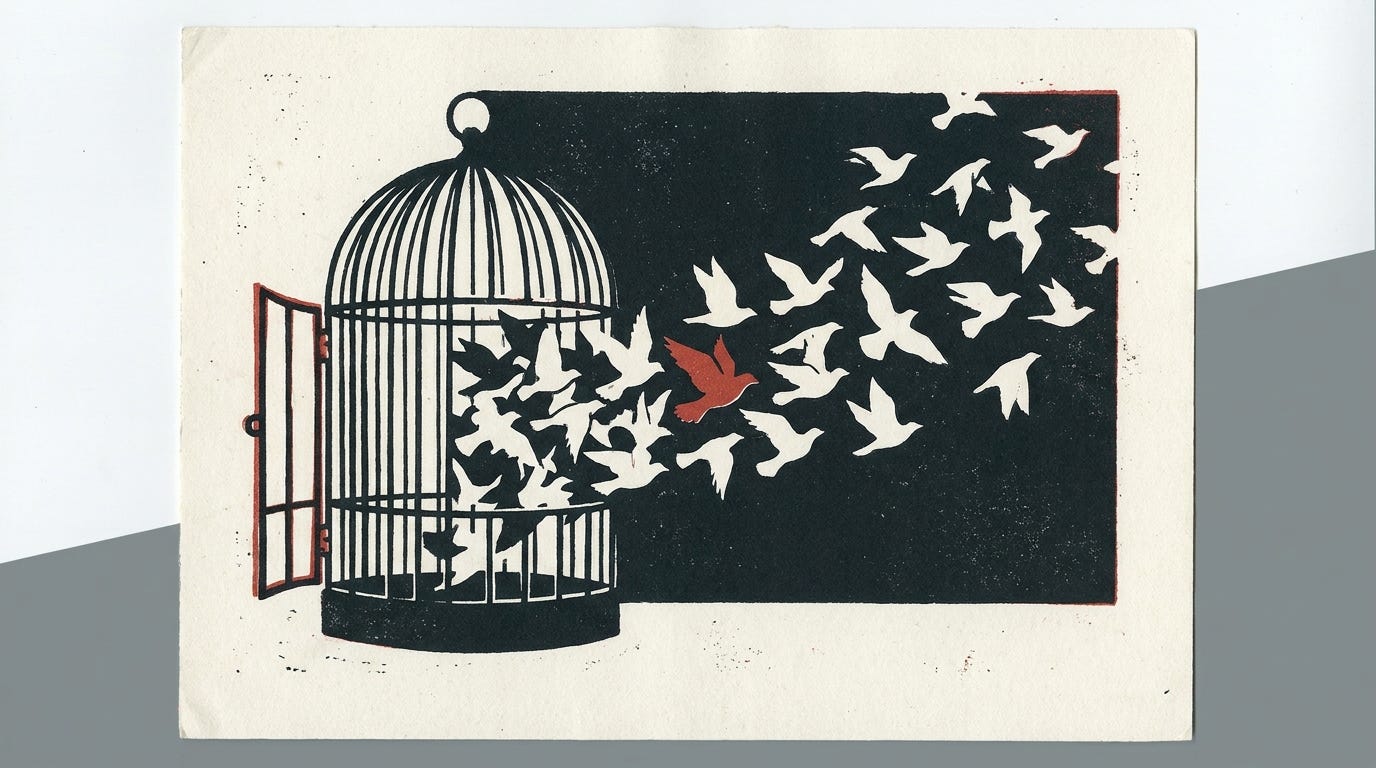
And the strangest part? Most of us are going along with it. We’re applying for the badge reissue, adjusting our commutes, suppressing the quiet thought that whispers: This doesn’t make any sense. Why are we willingly re-entering a structure that offers us less freedom, less focus, and less life? The question is not being asked in boardrooms or op-eds. It’s being suppressed by a deeper apparatus — one the Canadian sociologist Erving Goffman named over sixty years ago, and one that is now completing its quietest restoration.
The House of Correction That Forgot Its Bars
Goffman never wrote about open-plan offices. He wrote about total institutions — places like prisons, mental hospitals, military barracks, and monasteries where every aspect of life is conducted in the same place, under the same authority, according to a rigid schedule, and in the company of others who are all treated alike. The inmate — his word — surrenders their old self at the door. Their clothes are replaced with a uniform. Their name becomes a number. Their daily movements are synchronized with a bell. Their personal possessions are inventoried and stored. They are processed, sorted, and stripped of the roles that once defined them outside.
The modern office, of course, is not a prison. But the resemblance is not accidental. Goffman’s key insight was that total institutions operate through what he called the mortification of the self — a slow, systematic erasure of the individual’s capacity to manage their own identity. You don’t need walls and guards to achieve this. You only need to control the conditions under which a person can be a person.
Consider the rituals of the return: the badge, the assigned desk, the mandatory start time, the pre-approved break windows, the expectation that you will surrender your home self for eight hours. Did you customize your home office? Did you build a routine that fit your circadian rhythms? Did you reclaim time for exercise, for reading, for simply staring out a window without guilt? The return to office reverses all of that. It gathers these fragments of autonomy and systematically shreds them. And it does so with your consent — because the alternative, the implication goes, is failure, unemployment, or exclusion from the tribe.
The most dangerous institutions are the ones that convince you the cage is a privilege.
The Invisible Architecture of Compliance
Why do we submit? Goffman would point to a structural force that is older than any CEO or policy memo: the human need for belonging, combined with the fear of expulsion. Every total institution relies on the fact that the individual cannot bear the thought of being outside the group. The prisoner accepts the rules because the alternative — isolation — is worse. The soldier obeys because the unit is family. The office worker returns because the paycheck is not just money; it is the ticket to social legibility.
But there is a second, more subtle mechanism at work. Goffman described the institutional circuit — the feedback loop in which the institution generates the very problems it claims to solve. The return-to-office mandate is justified by a crisis of “culture” and “collaboration.” But the crisis was itself created by the institution’s own prior decisions: the open-plan layouts that destroyed focus, the endless meetings that replaced work, the performance metrics that turned professionals into data points. The institution then prescribes the cure — more of the same — and we comply because we have been trained to see the institution as the only source of solutions.
This is the structure of inevitability. The pandemic briefly broke the circuit. It revealed that work could happen without the commute, the badge, the surveillance. For a moment, the individual regained the ability to manage their own time, space, and identity. That was a threat to the total institution’s primary asset: control over the shape of a life. The return to office is not about productivity; it is about reasserting that control. And it is succeeding because the alternative — the freedom of the remote worker — has been recast as a danger. Loneliness. Career stagnation. Loss of community. The institution has reframed its own cage as a sanctuary.
What look like solutions to the problem of work are actually the problem itself, wearing a tie.
The Stakes of Re-Entering Without Asking
If this were merely a nuisance — a longer commute, a less comfortable chair — the stakes would be low. But the return to office is a rehearsal for a deeper surrender. Every time we accept a mandate without asking why, we weaken the muscle of critical thought. We train ourselves to see the institution’s demands as natural, inevitable, beyond question. This is not hyperbole; it is the foundation of total institutions. Goffman observed that the most pernicious effect of institutional life is the loss of the capacity to imagine alternatives. The inmate stops believing that any other world is possible.
We are already seeing this atrophy. The conversation around return-to-office has been reduced to a binary: you’re either pro-commute or anti-work. The third position — the question of why this structure is necessary at all — has been erased. Managers frame it as “culture.” Employees frame it as “inflexibility.” Neither side touches the deeper reality: that the structure of the office itself is a technology of control, and that re-entering it voluntarily is a form of ideological compliance that weakens the self.
What is at stake, then, is not just your morning or your evening or your gas bill. It is your relationship with authority. It is your ability to recognize when you are being processed. It is the preservation of a private self that can resist the mortifications that modern institutions — not just offices, but platforms, bureaucracies, hospitals, universities — perform on you every day. If you cannot see the cage, you will eventually mistake it for the world.
The Mortification of the Self, One Badge Scan at a Time
Let us be precise about what the return to office demands of the self. You must leave your home — the only space where you have full sovereignty — and enter a space designed by someone else, for someone else’s priorities. You must adjust your body to a rhythm that may not match your biology. You must perform a version of yourself that is approved: collegial, productive, uncomplaining. You must wear clothes that signify compliance. You must accept that your attention will be fragmented by interruptions, your privacy will be porous, your time will be owned.
This is not a conspiracy. It is a structure. Goffman would say that the office is not a total institution in the strict sense — you can leave at 5 PM, you are not locked in — but it functions as a partial institution that aims to control the self during waking hours. And because it is partial, it is more insidious. The inmate of a prison knows they are imprisoned. The office worker, by contrast, is told they are free. The badge is called an “access card.” The schedule is called “flexibility.” The uniform is called “professional attire.” The mortification is hidden beneath a vocabulary of choice.
The most effective cages are the ones that offer you a key — and then convince you that locking the door is your own decision.
A Philosophical Posture for the Thinking Citizen: The Unshakable Question
The return to office is not a policy debate. It is a test. It asks: Will you accept the structure as given, or will you ask what the structure is doing to you? The question nobody is asking is the only one that matters: Why am I being asked to surrender a freedom I have already tasted, and why am I willing to do it?
To ask that question is to step outside the institutional circuit. It is to refuse the binary of compliance versus complaint. It is to hold the tension between the necessity of work and the sovereignty of the self — and to demand that any structure that claims your time justify itself in terms of human flourishing, not control.
The posture of the thinking citizen in this moment is not rebellion. Rebellion is too easy — it allows the institution to define the terms of opposition. The posture is permanent inquiry. Every badge scan, every commute, every meeting request is an opportunity to ask: Is this arrangement serving my full humanity, or am I being processed? The answer may sometimes be that the structure is necessary. But the act of asking keeps the self intact.
Goffman wrote that the inmate’s only defense against mortification is the maintenance of a distance from the role. You can do the job without letting the job do you. You can enter the office without surrendering the pieces of yourself that the office cannot see. You can comply with the schedule while keeping an inner reserve of refusal. This is not passive resistance; it is active awareness. It is the refusal to let the institution define the whole of who you are.
The return to office is a small cage, but cages are always small at first. The question is whether you will notice before it becomes the only world you remember.