


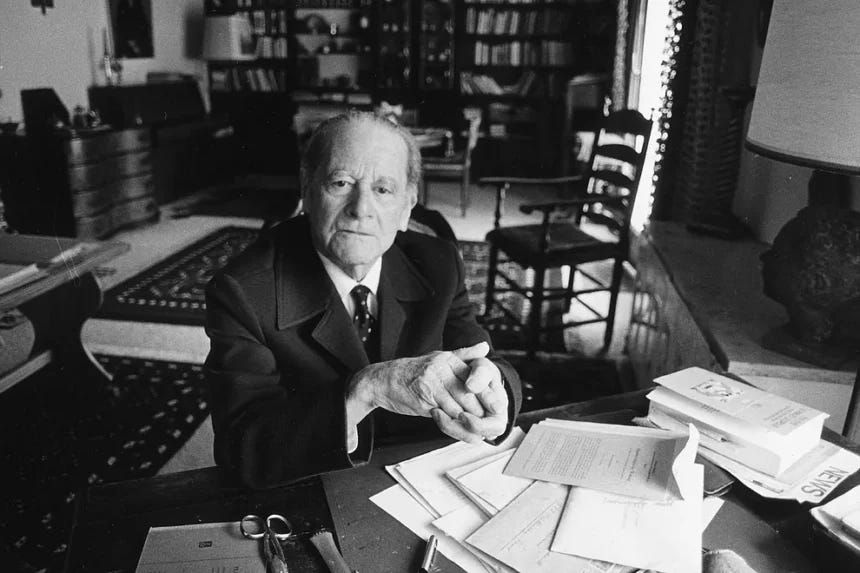
Carl Schmitt (1888–1985) remains one of the most controversial yet influential figures in modern political theory. A notable German legal theorist, his work challenges the very foundations of liberal democratic ideals by asserting that political identity is fundamentally defined by a binary classification: the friend-enemy distinction.
Schmitt’s ideas emerged during the politically turbulent era of the Weimar Republic. He argued that recognizing adversaries is necessary to foster unity among allies, characterizing modern politics not as a search for consensus, but as a “perpetual courtroom” defined by existential struggle.
The Roots of Radical Thought
Schmitt’s intellectual journey was shaped by the limitations of parliamentary democracy and the chaos of his time. Critical of the liberal ethos, he identified its roots in the philosophical traditions of thinkers like Hobbes and Spinoza, ultimately leading him to justify authoritarian governance as a response to societal instability.
He believed that constitutional norms often failed to represent the true popular will, arising instead from a fragmented political process. This skepticism underpinned his belief that the state must be prepared to defend itself against existential threats, even at the cost of democratic principles.
The condition of man... is a condition of war of everyone against everyone.
Thomas Hobbes
Schmitt viewed this inherent potential for conflict as the baseline of human political organization, rejecting the optimistic view that laws alone could contain the chaos of the political.
The Essence of the Political
In his seminal 1927 text, The Concept of the Political, Schmitt articulates that politics is a dynamic arena defined by existential struggles. This framework transcends conventional ethical or economic considerations.
The Nature of the Distinction
Schmitt famously articulated his central thesis regarding the specific distinction to which political actions can be reduced:
The specific political distinction to which political actions and motives can be reduced is that between friend and enemy.
Carl Schmitt
This distinction operates on the premise that enmity is a physical threat. It is not merely a social disagreement; it is a conflict that cannot be resolved through negotiation. The identification of an enemy serves as a catalyst for political unity among friends, creating a fluid landscape where allegiances shift based on survival.
Politics as a Perpetual Courtroom
Schmitt presents the notion that modern politics has become akin to a perpetual courtroom, dominated by legalistic discourse. He offers a scathing critique of parliamentary democracy, which he viewed as a mere “talking shop” disconnected from the realities of mass political engagement.
He contends that the liberal reliance on deliberative consensus is a banal and ineffective approach to governance. It fails to account for deeper conflicts rooted in identity, class, and ideology.
Politics have no relation to morals.
Niccolò Machiavelli
Much like Machiavelli, Schmitt argues that the attempt to negotiate political differences through discussion often ignores the primal nature of power. Consequently, politics devolves into a legalistic arena where decisions are made based on abstract principles rather than the concrete realities of societal divisions.
Sovereignty and the State of Exception
Central to Schmitt’s thought is his concept of sovereignty. He posits that true authority lies not within established legal norms, but with those capable of enacting decisions that suspend the law.
The sovereign is he who decides on the state of exception.
Carl Schmitt
This famous assertion highlights that:
Legal orders are founded on sovereign decisions, not just democratic consensus.
The State of Exception reveals the true locus of power during a crisis.
Legitimacy is determined by the ability to act decisively when norms collapse.
Critiques and Contemporary Relevance
Schmitt’s theories have generated significant controversy, particularly due to his affiliations with the Nazi regime. Critics argue that his emphasis on conflict risks oversimplifying complex social dynamics and may inadvertently justify authoritarian governance.
However, the legacy of Schmitt’s thought remains undeniable. His insights continue to resonate in contemporary discussions regarding:
Political Identity: How groups define themselves through exclusion.
Sovereignty: The balance between legal authority and emergency powers.
Global Politics: The challenges of intervention and territorial boundaries.
Ultimately, Schmitt’s work serves as a stark reminder of the fragility of liberal institutions and the enduring power of the friend-enemy distinction in an increasingly fragmented world.
“Ultimately, Schmitt’s work serves as a stark reminder of the fragility of liberal institutions and the enduring power of the friend-enemy distinction in an increasingly fragmented world.”
I think of his perspective as an enduring obstacle to the friend-enemy paradigm
This is well written and interesting, although from my perspective, this essay goes beyond practical reality when describing that framework as moving beyond “conventional ethical or economic considerations”, that makes Schmitt’s theory neater and more self contained than it ever was. In reality, such as Weimar and interwar times, where that Schmitt mostly operated within, political identity and friend enemy distinctions are not floating existential categories but are constituted through political economic architecture, there were credit regimes, cartelization, regulatory harmonization, capital mobility, and patterns of regional extraction that were deeply engrained within, and co-generating with the very antagonisms Schmitt then theorizes. And there was powerful special interests groups coordination, economic structuring, and legal administrative designs that were generating the very conflicts his framework was based around there
And if you follow Schmitt’s own work-path, its hints at this, his work-path is full of pivots that dont look like consistent analyst of “the political” and more like a jurist changing his concepts to whichever institutional project could concentrate authority. In the 1920s–early 1930s he develops the exception/decision framework and goes after parliamentary pluralism, while still operating in a Weimar setting where he argues about who should “guard” the constitution (his 1931/32 constitutional writings sit within that). But thens once the new order takes hold, Schmitt quickly commits himself to the regime, he joins the Nazi Party in 1933 and becomes deeply involved in its legal-institutional consolidation, ginning up juridical rationalizations for sidestepping constitutional constraints.