


Are we safer when our neighbors live in fear? A look at the new executive orders, the protests, and the dangerous comfort of ‘emergency’ politics.
The Midnight Signature
I want you to pause and think about the word ‘emergency.’ We usually associate it with natural disasters—hurricanes, earthquakes, sudden fires. But what happens when an emergency is declared not by nature, but by a signature? The recent executive orders promising millions of deportations aren’t just policy; they are a signal.
They tell us that we are entering a time where the normal rules of compassion and due process are suspended.
The tradition of the oppressed teaches us that the ‘state of emergency’ in which we live is not the exception but the rule.
– Walter Benjamin, ‘Theses on the Philosophy of History’
Question 1: Can a Permanent Emergency Coexist with Democracy?
I’ve been wrestling with this question since the announcement. If we accept that the border is in a permanent state of crisis, we also accept that the government needs permanent ‘special powers’ to deal with it. This is a trap. The danger is not just to the immigrant, but to the very idea of a republic that answers to its people rather than its fears. Once we allow the executive branch to bypass the slow, messy work of democracy in the name of safety, we rarely get that power back. It’s a one-way street toward authoritarianism, paved with our own anxiety.
Question 2: Does the ‘Alien’ Have a Face?
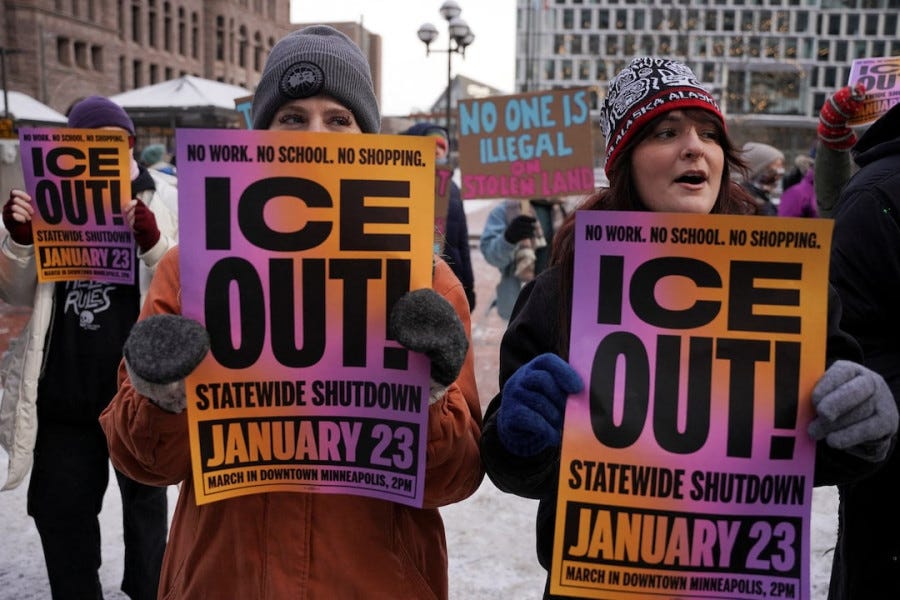
It is easy to cheer for ‘security’ when the cost is paid by faceless numbers. ‘Millions’ is a statistic. But the raids in Minneapolis? Those were families. Those were people who cook dinner, walk their dogs, and worry about their kids’ grades. To accept this overhaul, we have to perform a kind of mental surgery—we have to cut out the part of our empathy that recognizes the stranger as a human being.
It is a terrifying thing to have to love what death can touch.
– Hannah Arendt
We are being asked to shut our eyes to the reality of suffering in our own backyards. Don’t let them make you blind.
Question 3: Is the Law a Shield or a Sword?
With the Justice Department now probing opposition and campaign contributions, the vibe has shifted from ‘enforcement’ to ‘intimidation.’ The law is supposed to be the bedrock we stand on, not a weapon wielded against us. When I see thousands protesting, I don’t just see anger; I see a desperate defense of the idea that justice should be blind. If we lose that, we lose everything.
Go Deeper
Step beyond the surface. Unlock The Third Citizen’s full library of deep guides and frameworks — now with 10% off the annual plan for new members.
The Verdict of History
The ‘Third Citizen’ is anyone who realizes that their safety is tied to the safety of the most vulnerable. We cannot build a fortress high enough to keep out the consequences of our own cruelty. The choice isn’t between open borders and security; it’s between a society based on law and a society based on force. Choose wisely.