


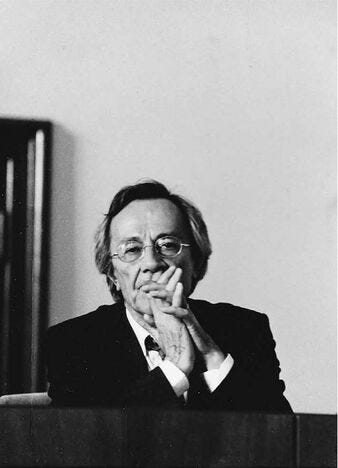
In the landscape of contemporary philosophy, few concepts have proven as prophetic as Jean-François Lyotard’s critique of the grand narrative. His work explores the profound impact of a specific skepticism—an “incredulity”—that has come to define our modern era. Central to this concept is Lyotard’s assertion that the decline of universal explanations for cultural, historical, and social phenomena has led to a fragmented understanding of reality.
This fragmentation is particularly pronounced in today’s digital age, where an overwhelming diversity of narratives can distort public discourse and complicate our sense of shared identity and community. As we navigate a world where the “truth” seems increasingly subjective, we are witnessing the mechanics of what can be termed the Incredulity Engine.
There are no facts, only interpretations.
Friedrich Nietzsche
The Postmodern Condition
Jean-François Lyotard (1924—1998) was a pivotal figure in the development of postmodern philosophy. His seminal work, The Postmodern Condition (1979), outlines the decline of metanarratives—those overarching theories that claim to explain historical or cultural phenomena in definitive ways. He introduced the concept of “incredulity toward metanarratives” as a hallmark of postmodern thought, challenging the validity of universal truths and emphasizing localized perspectives.
Intellectual Foundations
Lyotard’s rejection of grand narratives is framed within a broader critique of the Enlightenment’s emphasis on rationalism and objectivity. He argued that reason should not be viewed as a universal faculty but rather as a product of specific social contexts. This shift supports a more pluralistic approach to knowledge, echoing the sentiments of theorists who suggest that reality is increasingly mediated through symbols and simulations.
Rejection of Rationalism: Reason is context-specific, not universal.
Little Narratives: A shift toward petits récits (localized narratives) that resist totalizing frameworks.
Pragmatic Knowledge: Emphasizing multiplicity over unity in a complex global society.
The Incredulity Engine Explained
The “Incredulity Engine” refers to the mechanism through which society’s faith in metanarratives has been systematically undermined. Historically, narratives like the Enlightenment’s promise of scientific progress or Marxism’s vision of a classless society functioned as legitimizing devices for knowledge. They provided a teleological unity that masked the complexities of lived experiences.
Lyotard posits that the delegitimation of these grand narratives has necessitated a reconfiguration of how knowledge is validated. In place of consensus, we now see paralogy—a term signifying the introduction of innovative ideas that challenge established norms. Rather than relying on established criteria for competence, paralogical legitimation promotes disruptive creativity.
