


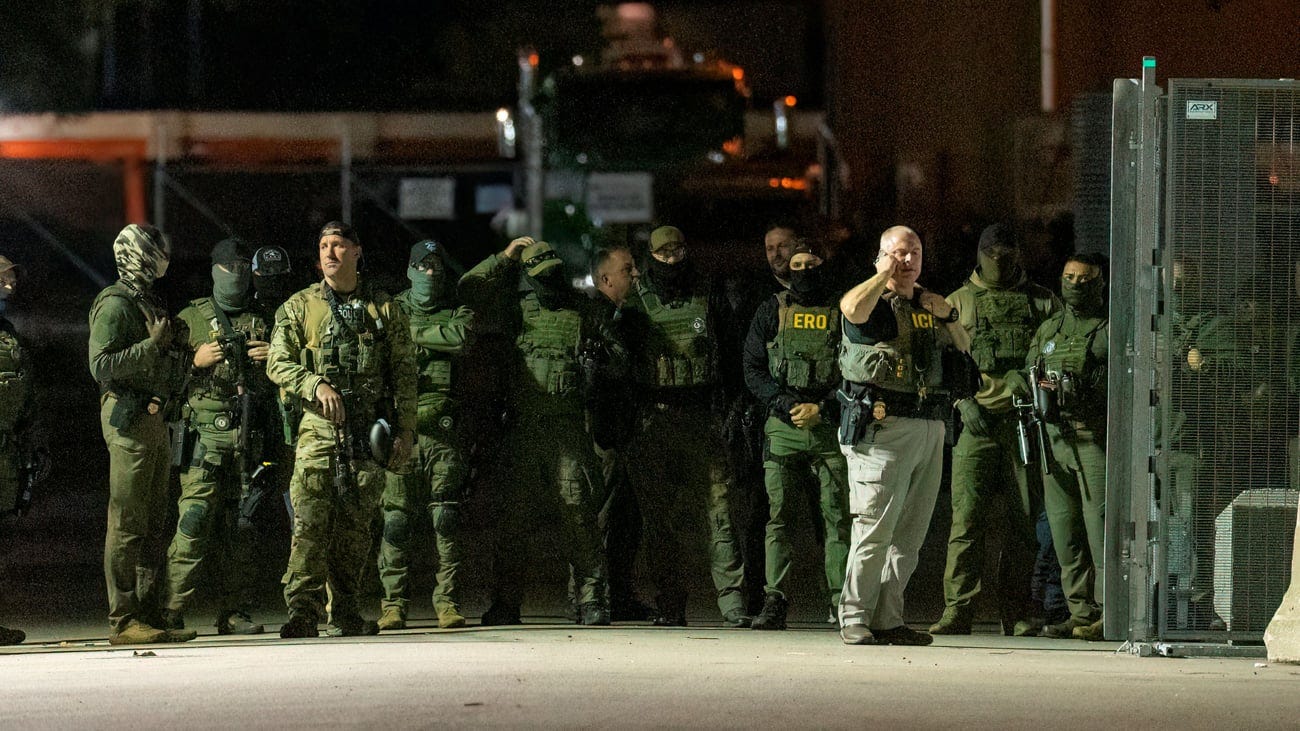
In an era where executive power often seems unchecked, a recent Supreme Court decision on National Guard deployment offers a profound reminder: even the highest office operates within an enduring constitutional framework. This ruling reveals not just a legal limit, but a crucial reassertion of federalism and the rule of law.
The Enduring Question of Boundless Authority
In a period marked by escalating political polarization and increasingly expansive claims of executive authority, the U.S. Supreme Court’s recent intervention regarding the deployment of the National Guard serves as a vital constitutional bulwark. The case, involving former President Trump’s attempt to federalize National Guard troops for immigration enforcement in Chicago, transcends mere legal precedent; it illuminates the enduring tension between centralized power and state sovereignty, forcing us to confront the true limits of presidential command. This is not an abstract debate; it speaks directly to the fragility of democratic institutions and the constant vigilance required to maintain a balance of power.
The Court’s refusal to sanction an unfettered executive deployment of military-like forces on domestic soil, especially against the backdrop of local objections and claims of non-violent protest, signals a crucial moment. It underscores that even in times of perceived crisis, the architecture of American governance is designed to resist impulses towards unchecked power, grounding us in a historical commitment to the rule of law. What then, does this ruling teach us about the subtle but dangerous encroachments on our fundamental freedoms?
Unpacking the Ruling: The Mechanics of a Constitutional Check
The core of the issue stems from former President Trump’s invocation of Title 10 to federalize National Guard personnel from Illinois and Texas for “Operation Midway Blitz” in Chicago. The stated goal was to protect ICE agents during protests at an ICE facility in Broadview, Illinois. However, local officials consistently maintained that these protests were largely non-violent, directly contradicting the administration’s claims of threats such as shots fired and vehicle ramming.
A lower court judge initially blocked the deployment, a decision upheld by the 7th Circuit Court of Appeals. The Supreme Court then refused to lift this order, effectively cementing the block. The judicial reasoning centered on historical restrictions concerning the use of the military for domestic law enforcement, asserting that federalizing the Guard for such purposes was unlawful without first deploying regular U.S. military forces. This marks a significant judicial intervention, particularly as it pertains to a broader pattern of military deployments to Democratic-led cities. The ruling exposes the illusion of unchecked executive power, reaffirming that even in moments of perceived urgency, constitutional checks on authority remain paramount.
Why It Matters: Federalism Under Strain and the Specter of Overreach
This ruling is more than a simple legal decision; it is a profound articulation of what is at stake when the lines of federalism blur. On one hand, the executive branch’s thesis often posits a need for swift, decisive action in the face of perceived threats, arguing for inherent presidential prerogative to protect federal interests. This perspective, often amplified in moments of national unrest or perceived instability, can easily justify expansive interpretations of authority, viewing state objections as impediments to national security or order.
However, the antithesis, robustly upheld by the courts, is the enduring principle of state sovereignty and the carefully delineated separation of powers. This foundational aspect of American governance acts as a crucial barrier against the centralization of power, ensuring that states retain authority over their own internal affairs, including law enforcement and civil unrest. As Alexis de Tocqueville observed in “Democracy in America,” the strength of American democracy lay not just in its federal structure but in the vibrant autonomy of its local and state governments. When one branch or level of government oversteps, it doesn’t just violate a legal code; it erodes the very trust that underpins a functioning republic.
The true test of a civilization is not the census, nor the size of its cities, nor the crops--but the kind of man the country turns out.
– Ralph Waldo Emerson
The synthesis emerging from this judicial intervention is a reaffirmation that such constitutional guardrails are not mere formalities but essential safeguards. The Supreme Court’s decision reminds us that the balance of power, though often strained by political expediency, remains fundamentally designed to protect citizens from potential abuses. It’s a testament to the idea that law is not merely an instrument of power, but a framework that limits its exercise, forcing even the most powerful to contend with established precedent and the will of the people as expressed through their states.
Navigating the New Landscape: Reclaiming Constitutional Vigilance
For us, the citizens, this decision offers a critical lesson in civic engagement and constitutional literacy. It demands that we look beyond the immediate headlines and partisan divides to understand the deeper implications of executive actions and judicial responses. How do we apply this insight into our daily lives and our understanding of governance?
Insist on Constitutional Adherence: We must hold our elected officials accountable to the separation of powers and the principles of federalism. The executive’s impulse for unilateral action must always be weighed against the constitutional limits that define our republic.
Support Independent Judiciary: The courts, often maligned and politicized, serve as the final arbiter in these crucial disputes. An independent judiciary is not a luxury but an existential necessity for preventing unchecked power.
Engage with State and Local Governance: This ruling highlights the power of state sovereignty. Active participation in state and local politics is not merely an alternative to federal engagement but a direct defense against overreach. As Václav Havel wrote in “The Power of the Powerless,” even seemingly small acts of living in truth can undermine the “post-totalitarian system” of lies and control. This means actively upholding truth about local conditions against federal narratives.
Force is as pitiless to the man who possesses it, or thinks he does, as it is to its victims.
– Simone Weil, “The Iliad, or The Poem of Force”
Ultimately, this Supreme Court ruling is a timely reminder that the architecture of our democracy is not self-sustaining. It requires constant vigilance, an informed citizenry, and a collective commitment to the principles that limit power, rather than succumbing to the dangerous comfort of concentrated authority. Our freedom hinges on our willingness to recognize and defend these boundaries.