


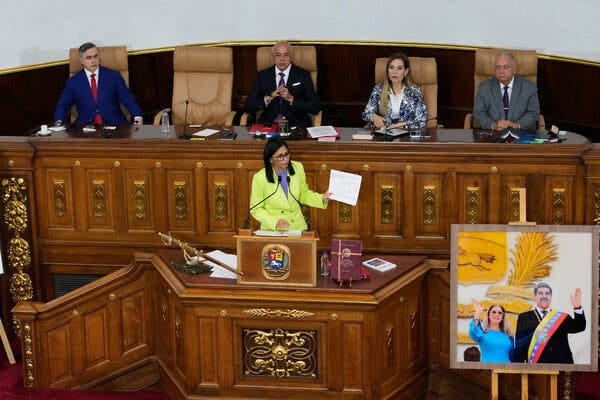
I used to think removing the dictator meant freeing the people. The rise of Delcy Rodríguez proves me wrong. A look at the ‘Zombie Regime’ and the trap of stability.
I Thought the Snake Was Dead
I must confess to you that I celebrated too early. When the news broke that Maduro was in custody, I felt that familiar surge of vindication—the feeling that justice, however delayed, had finally arrived. I assumed that without the dictator, the dictatorship would crumble. But I was looking at the world through a simplistic lens, one that ignores the deep, tangled roots of power. The most dangerous moment for a people is not when the tyrant falls, but when the system realizes it doesn’t need him to survive. I failed to see that the machine was already rebuilding itself before the handcuffs even clicked.
The Big Question: Who Actually Rules?
The question we need to ask isn’t ‘Is Venezuela free?’ but ‘Who is currently renting the palace?’ We are watching a fascinating and terrifying experiment in real-time. Can a regime decapitated by a foreign power simply grow a new head and keep eating? The philosopher Simone Weil understood this mechanics of force better than most modern analysts.
To the same degree, though in different fashions, those who use [force] and those who endure it are turned into stone.
– Simone Weil
The regime in Caracas hasn’t changed its nature; it has simply shifted its weight. It is still a creature of force, turning both its new leaders and its citizens into stone.
The Evidence: A Cabinet of Survivors
Look at what Delcy Rodríguez is actually doing. She isn’t dismantling the police state; she is fortifying her corner of it. By promoting Major General Gustavo Gonzalez, she is building a wall against her own internal rival, Diosdado Cabello. It’s a game of chess played with live ammunition. And while she fights this internal war, she is selling the oil the U.S. desperately wants, earning praise from Trump as ‘good to deal with.’ It brings to mind the insights of Octavio Paz on the nature of the mask in Latin American politics.
The Mexican, whether young or old, criollo or mestizo, general or laborer or lawyer, seems to me to be a person who shuts himself away to protect himself... His face is a mask and so is his smile.
– Octavio Paz
Rodríguez is wearing the mask of the pragmatist for the Americans, and the mask of the loyalist for the Chavistas. But behind the mask, the machinery of the state grinds on.
Go Deeper
Step beyond the surface. Unlock The Third Citizen’s full library of deep guides and frameworks — now with 10% off the annual plan for new members.
The Implication: You Are Watching a Transaction
This leaves us in a dark place. It implies that ‘liberation’ was never the goal—stability was. The United States gets its oil, the Chavista elite gets to keep their stolen wealth (as long as they switch allegiance), and the people? They get a new face on the nightly news. We are witnessing the solidification of a transactional tyranny. If we don’t recognize this now, we become complicit in the illusion that a change of management is the same as a change of heart.