

The Epicurean Founder: 7 Ancient Decisions to Build Wealth Without Losing Your Tranquility
A philosopher who died in 270 BCE diagnosed the exact anxiety epidemic sitting inside every “successful” person’s Slack notifications.

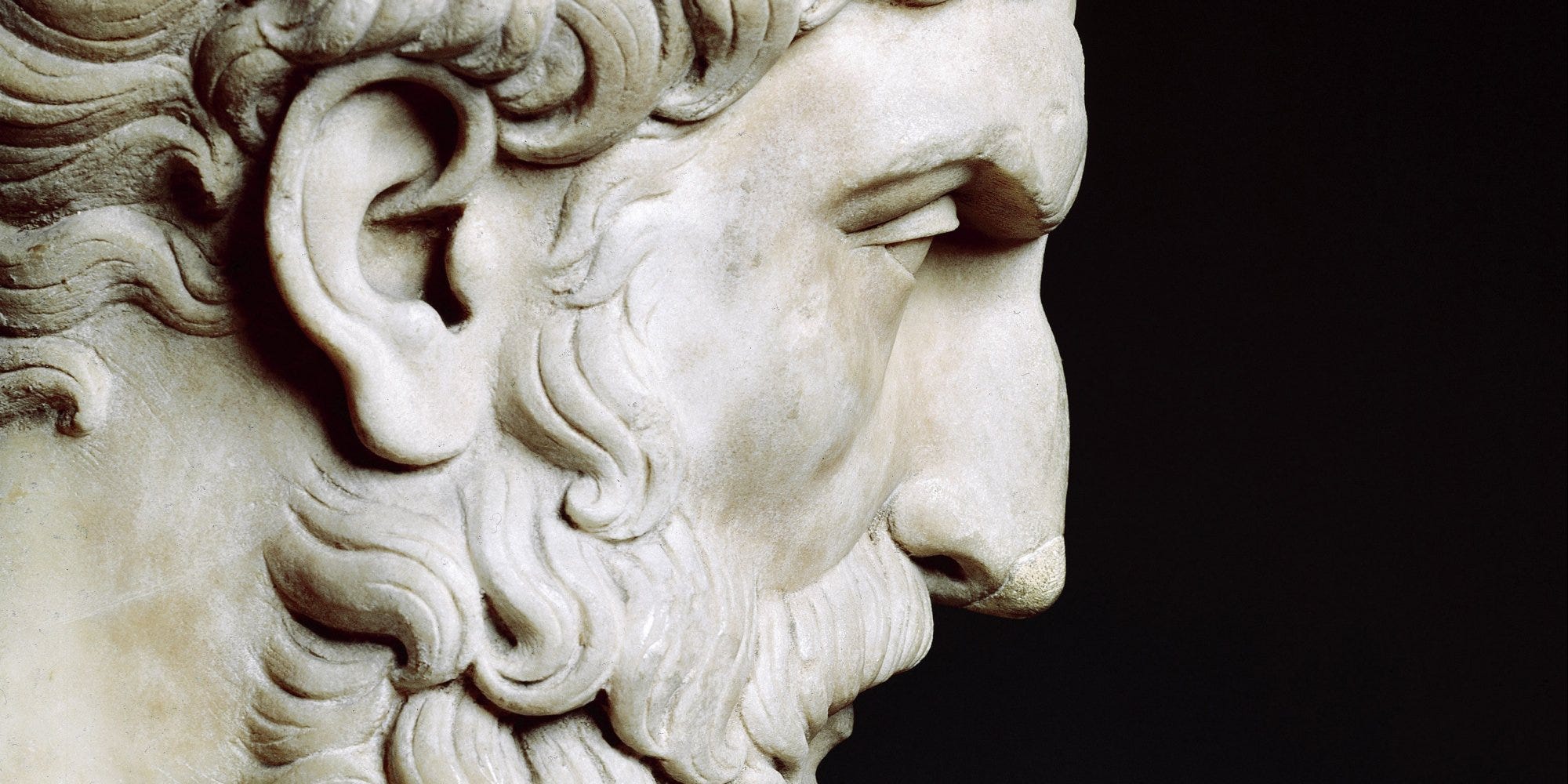
He closed a $40 million round eleven days ago. The press release went out, the LinkedIn congratulations piled up into the hundreds, his co-founder cried in the all-hands meeting. He has not slept more than five hours a night since.
Not because the work got harder. Because now there’s a number he has to protect. A valuation to justify. A board that expects the next round to be bigger. A competitor who raised $60 million last month, which means his win already feels, somehow, like falling behind.
This is not a personality flaw. It is a design feature of a system that was built, from the ground up, to make sure the finish line keeps moving the moment you approach it.
A 2023 study out of the University of Zurich found founders reporting anxiety and depressive symptoms at rates nearly double the general working population — and the correlation with wealth was almost nonexistent. The money didn’t fix it. In many cases, the money accelerated it.
There is a two-thousand-three-hundred-year-old explanation for exactly why, and it doesn’t come from a wellness app. It comes from a man who ran the strangest and most successful “startup” in the ancient world — and who left behind a warning that modern wealth-building has almost perfectly ignored.
The Man Who Built a Company and Called It a Garden
Epicurus was born around 341 BCE on the island of Samos, the son of an Athenian colonist family with no real standing — his father, by most accounts, scraped by as a schoolteacher. He grew up on the margins of citizenship, watched empires reshuffle around him during the chaos following Alexander’s death, and by his mid-thirties had seen enough of ambition’s wreckage to draw a hard conclusion about it.
Around 307 BCE, he did something almost nobody in Athens did: he bought a house with a garden, and he simply stopped trying to win the city.
He didn’t chase political office. He didn’t compete for status in the Assembly. He gathered a small community — friends, students, and unusually for the time, women and enslaved people as full participants — into a shared domestic life focused on producing their own food, thinking clearly, and, above all, not being anxious. They called it, simply, the Garden.
It ran for centuries after his death. Longer than most empires he watched collapse. He built something that outlasted Athens’s entire democratic experiment, and he did it by refusing to scale.
The Idea Nailed to the Garden Gate
Epicurus’s core insight, stripped of the later caricature that turned “Epicurean” into a synonym for indulgence, was almost mathematically simple: pain comes from unmet desire, and most of our desires are manufactured, not natural.
He sorted every want a human being can have into three categories. Natural and necessary desires — food, shelter, basic security — are easily satisfied and bring real relief when met. Natural but unnecessary desires — a better meal, a nicer house — are fine in moderation but start to cost more than they return. And then there are the vain and empty desires — fame, luxury, being envied, being first — which have no natural ceiling at all. You can satisfy hunger. You cannot satisfy the desire to be more impressive than your neighbor, because your neighbor’s neighbor is always richer than both of you.
His most famous formulation, from the Letter to Menoeceus, cuts through three millennia of marketing in one line: “Nothing is enough for the man to whom enough is too little.” Wealth, in his accounting, was never a quantity. It was the gap between what you have and what you think you need — and that gap can be closed by subtraction as easily as by addition.
This is the part almost nobody tells you about ancient wisdom traditions: they weren’t anti-money. Epicurus accepted donations, managed property, ran what was functionally a self-sustaining commune with real economic logistics. He wasn’t against wealth. He was against the specific, addictive category of wealth that requires someone else’s envy to feel real.

Seven Decisions From the Ledger He Kept
Strip his letters down to their practical residue and you get something closer to a founder’s operating manual than a monk’s renunciation. Seven decisions, all still available to you, none of them requiring you to leave civilization:
One — Set your “enough” number before the market sets it for you. Epicurus insisted you define natural, necessary desire in advance. Most people never set a number at all; they let the last funding round, the neighbor’s renovation, or the algorithm’s feed define it for them in real time, forever.
Two — Audit every desire for whether satisfying it requires an audience. If the want disappears the moment no one is watching, it belongs to his third,
