


Ever wonder why politics feels so confusing? Join me as we pull back the curtain on five surprising truths about how power really works. From the quiet resistance of bureaucracy to the simple power of a clear decision, let’s explore the hidden dynamics that shape our world and rediscover our collective agency.
Unpacking the Political Enigma: A Personal Guide
If you’re anything like me, you often find yourself looking at the political world and feeling a mix of frustration and bewilderment. It’s like there’s a secret language, a hidden game, that only a select few truly understand. We see the headlines, the debates, the constant churn, but what’s actually happening behind the scenes? How do decisions really get made? Why does change feel so slow, or sometimes, entirely impossible?
Well, I’ve spent a fair bit of time observing and thinking about these very questions. What I’ve found are five truly counter-intuitive truths about how power actually operates. These aren’t just theories; they’re the unspoken rules that repeat themselves in governments and organizations everywhere. Let’s peel back the layers together and get a clearer view of what’s really going on.
The Bureaucratic Black Hole: Why Paperwork Wins
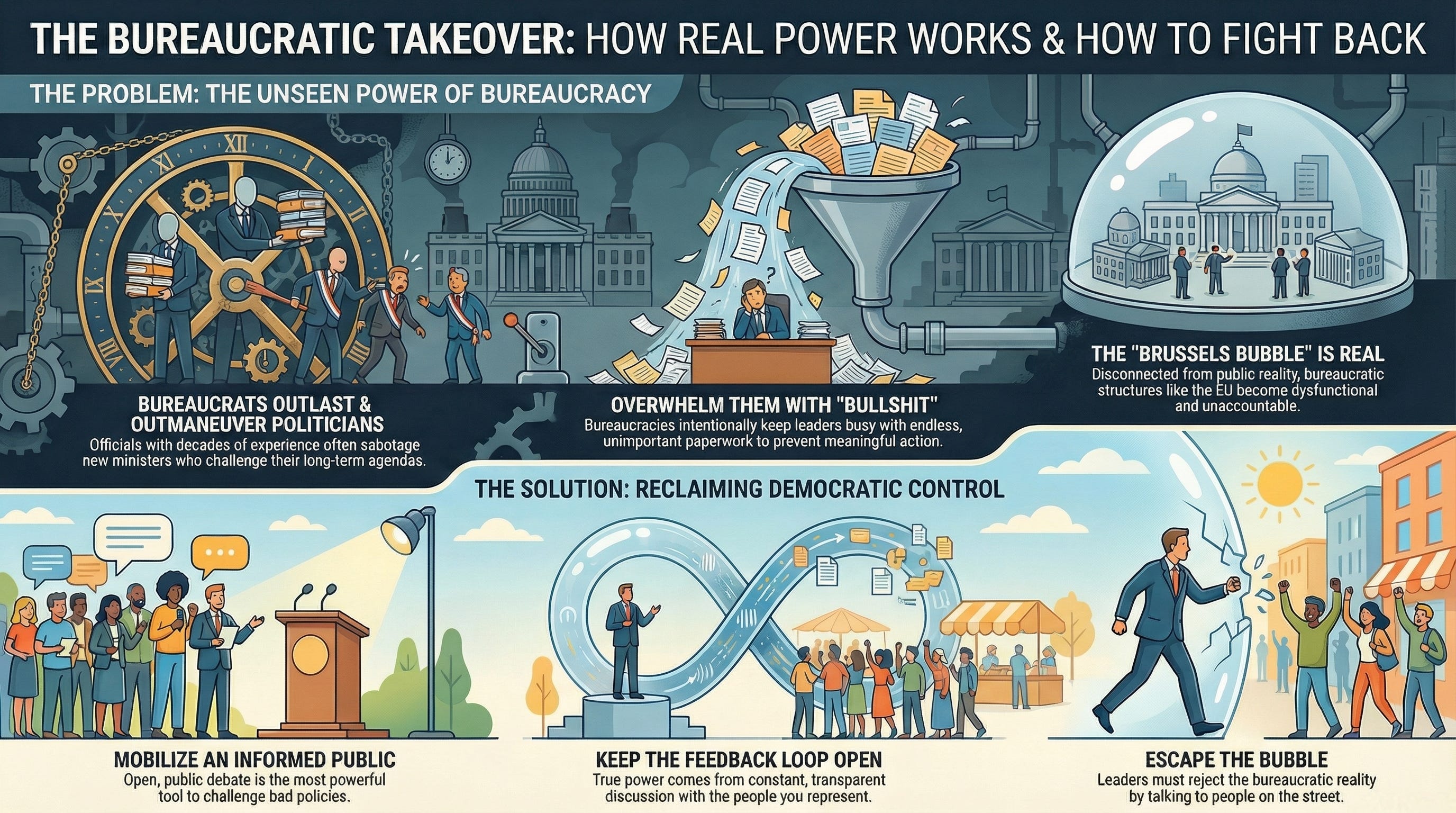
Here’s the first surprising truth: the people you elect often aren’t the ones truly holding the reins. The real, lasting power often sits with the permanent bureaucracy – the civil servants. They’re like the bedrock of the system, outlasting any politician who comes and goes. When an eager new leader arrives, full of ideas for change, they often walk into a subtle, undeclared war.
Power...is the ability not to have to learn.
– Karl W. Deutsch
The bureaucracy’s resistance isn’t usually dramatic; it’s a quiet sabotage. I’ve heard insiders describe it like this: ‘They will say yes and they really mean no and they will sabotage you in whatever way they can.’ Their most effective weapon? Exhaustion. They’ll inundate you with paperwork, drown you in procedures, and create a culture where ‘activity as opposed to action’ is the norm. The goal is to keep everyone so tired and overwhelmed that your agenda gets lost in the shuffle. It’s a powerful way to preserve the status quo without ever saying ‘no’ directly.
The Simple Art of Governing: It’s All About Choosing
Now, here’s a truth that cuts through a lot of the perceived complexity: governing is often made to seem far more difficult than it actually is. We’re told it’s about mastering endless technical details, but that’s a myth. The heart of good governance, as French Prime Minister Pierre Mendès France so brilliantly put it, isn’t about navigating a labyrinth; it’s simply about making a clear decision.
To govern is to choose.
– Pierre Mendès France
He wasn’t saying it’s about always making the right choice, but just the act of choosing. Think about that. The very act of deciding on a path and committing to it can reshape reality. A plan that seems impossible often succeeds precisely because a leader decides, with conviction, to pursue it. When you commit, you invest time, resources, and focus, often creating the conditions for success. So, when people tell you something can’t be done, I often wonder if they’ve truly tried to choose it.
Why Great Teams Just Happen: Beyond the Resume
We’re often taught that to build a great team, you hire the most impressive resumes. But in politics, and frankly, in many dynamic fields, I’ve seen that the best teams don’t get ‘hired’ in the traditional sense; they emerge organically from within a broader movement. This process creates a foundation of proven relationships, shared goals, and mutual trust that’s already been forged in the trenches.
This organic approach is incredibly revealing. Over time, you learn who fits where: who’s steady and reliable, who’s brilliant but maybe a little impractical, who can think big, and who can meticulously execute. This deep, practical understanding creates a cohesive unit that’s far more resilient than any team assembled purely from a list of credentials. It’s about how people actually work together, not just how they look on paper, and that’s a crucial distinction many leaders miss.
The Mirror Effect: Politicians Reflecting Us Back
Here’s a key to understanding a lot of political communication: many successful politicians follow a simple rule—never challenge your audience. Instead of trying to change minds, they listen intently, identify existing feelings, and then articulate those ideas back in a clear, compelling way. It creates that ‘aha moment’ where you, the listener, feel profoundly understood and validated.
This is often the secret sauce of populism—telling people what they already think, but giving them the words they couldn’t quite find themselves. A much rarer approach is the politician who truly seeks to educate their base, to lead them to a new understanding. This requires immense clarity and simplicity. Think of Lincoln or JFK. Even a modern figure like Vladimir Putin, in his domestic addresses, ‘explains things step by step by step’ using ‘very clear and very direct language’ to guide public opinion. It’s high-risk, high-reward, aiming to shape belief rather than just echo it. But remember, the appearance of impossibility is often the final stage before inevitability.
When the Impossible Becomes Inevitable: A Glimmer of Hope
This final truth offers a powerful reason for optimism, especially when things look bleak. Systems that seem utterly rigid and impossible to change are actually the ones most primed for a sudden, total transformation. When a system is in crisis and simply can’t adapt, the pressure for change builds beneath the surface until it becomes an irresistible force.
So, the moments when things feel most dire are often precisely when a breakthrough is most likely. The real question isn’t if change will happen, but how we ensure that when it does, it’s democratic and constructive. The very inflexibility of a failing system guarantees its eventual collapse, opening a door for something genuinely new. I find immense hope in this paradox.
Go Deeper
Step beyond the surface. Unlock The Third Citizen’s full library of deep guides and frameworks — now with 10% off the annual plan for new members.
Your Power to Choose: Understanding the Game
These five truths give us a clearer, less bewildered perspective on power. Realizing that bureaucratic resistance (Truth #1) can be broken by decisive choice (Truth #2) helps explain why so many good intentions falter. It’s not a lack of good ideas, but a failure to truly choose and commit. This requires a trusted, organic team (Truth #3) and the ability to connect with people’s real sentiments (Truth #4), all while knowing that seemingly unmovable systems are on the verge of breakthrough (Truth #5). This isn’t a game of grand, unchangeable forces, but of human dynamics.
For me, this shifts everything from helplessness to potential agency. The biggest obstacles aren’t invincible laws; they’re structures and habits that can be overcome with awareness, strategy, and conviction. If the real barriers to progress are often just layers of paperwork and a reluctance to choose a different path, then what kind of reality are you and I choosing not to create?