


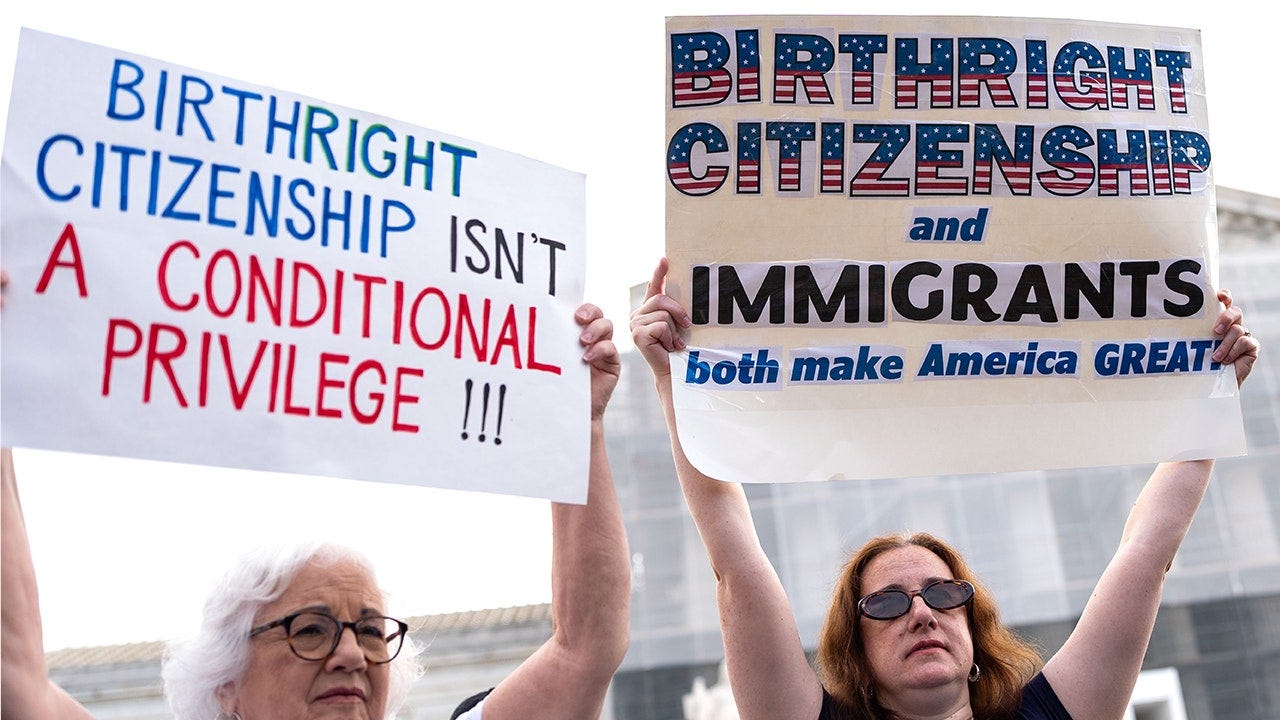
Join me in exploring the unsettling current challenge to birthright citizenship, delving into the historical echoes and psychological impact of redefining who we are as Americans, and how we might reclaim our sense of self amidst systemic uncertainty.
The Looming Question: Why Our Constitution Feels Suddenly Fragile
Have you ever felt that quiet hum beneath the surface of daily life, the sense that something fundamental is shifting, even if you can’t quite put your finger on it? That’s precisely the feeling I get when I look at what’s happening with birthright citizenship. It’s not just another political squabble; it feels like a deeper tremor, rattling the very foundations of who we are, individually and collectively, as a nation. We’ve always assumed certain things about citizenship, about simply being born here. But now, those assumptions are being quietly, precisely, dismantled. The narrative we’re being fed suggests this is a ‘fix,’ a ‘correction.’ But if you listen closely, you can hear the whirring of a hidden machine, working to redefine not just legal status, but our very sense of identity and belonging. It’s a managed perception, nudging us to accept a narrower definition of ‘us,’ and I believe it’s crucial for us to understand how this quiet reframing affects all of us.
The Fourteenth Amendment: More Elastic Than We Knew?
Think about the Fourteenth Amendment. Most of us probably remember it from history class, a crucial moment after the Civil War, designed to ensure that formerly enslaved people were recognized as full citizens. Its language seems so clear: “All persons born or naturalized in the United States, and subject to the jurisdiction thereof, are citizens of the United States...” But here’s the unsettling truth: even something as fundamental as a constitutional amendment isn’t immune to reinterpretation. Over the years, powerful forces, often driven by political expediency or economic interest, have sought to bend and reshape its meaning. It’s a reminder that even the strongest legal protections can become surprisingly elastic, stretching to accommodate new agendas. This isn’t just dusty legal history; it’s a demonstration of how a hidden machine, the continuous re-engineering of legal interpretation, allows past guarantees to be quietly undermined in the present. It makes you wonder, doesn’t it, what else we’ve taken for granted about our foundational laws?
The Ghost of Elk v. Wilkins: A Forgotten Case Returns to Haunt Us
Now, let’s talk about a ghost from the past that’s suddenly very much alive: the Supreme Court case of “Elk v. Wilkins” from 1884. Imagine John Elk, a Native American man who had left his tribal lands, living among white settlers, wanting to participate fully in the nation he called home. He tried to register to vote, asserting his right under the Fourteenth Amendment. But the Court denied him, claiming Native Americans weren’t truly ‘subject to the jurisdiction’ of the U.S. in the same way as others. It was a legal maneuver, a way to exclude a whole group of people from the promise of citizenship, based on the prevailing prejudices of the time. The chilling part? This almost forgotten case is now being dusted off, cited as a precedent for limiting birthright citizenship today. It’s an eerie inevitability, isn’t it? How old injustices, old legal fictions, can be plucked from history’s shelf and weaponized for contemporary political battles. It forces us to confront the idea that the past isn’t just history; it’s a living archive of tools that can be reactivated to serve new forms of exclusion.
The past is never dead. It’s not even past.
– William Faulkner
The Invisible Machinery That Defines Us
Beyond the legal arguments and the grand pronouncements of judges, this debate has a profoundly personal impact. If birthright citizenship is redefined, it’s not just an abstract constitutional change. It’s a new layer of invisible machinery that determines everything from whether a child gets a birth certificate without question, to their ability to go to school, access healthcare, or eventually, vote. Think of the bureaucratic crucible it creates: more forms, more verification, more hoops to jump through for people who have always considered themselves undeniably American. This is where the quiet horror sets in – the transformation of fundamental human dignity into a question of administrative approval. The system’s relentless drive to categorize and control creates a systemic contradiction: a nation that prides itself on individual liberty simultaneously subjects millions to the agonizing uncertainty of their own belonging. I believe this bureaucratic re-engineering of identity is one of the most insidious forms of control.
Living in the Shifting Sands: The Psychology of Unbelonging
What does it do to a person, or a society, when their very identity is perpetually questioned? It cultivates a deep psychological trap: a sense of precariousness, of being unmoored. Imagine growing up in a country, believing you belong, only to have that belief constantly challenged by shifting legal interpretations. This uncertainty doesn’t just affect those directly targeted; it ripples outwards, creating anxiety and suspicion throughout communities. When the very ground beneath your feet can change due to a court ruling or a new policy, how can you feel secure? This exploits a universal human weakness: our need for stability, for belonging, for a clear sense of who we are. It’s a powerful, quiet form of control, turning us inwards, making us focus on our own survival and status rather than on challenging the architects of this uncertainty. We become so preoccupied with proving our worth that we lose sight of the larger systemic shifts that put us in this position.
The Crafting of Crisis: Who Benefits from Our Disorientation?
This entire debate isn’t just happening; it’s being carefully managed and amplified. The way it’s framed in the news, the rhetoric used by politicians – it’s all part of a larger project to manufacture a crisis where perhaps none truly exists, or at least, not in the way it’s presented. We’re told it’s about national security, about economic strain, about preserving ‘our culture.’ But is it? Or is it about creating an externalized enemy, a ‘them,’ against whom ‘we’ can unite, distracting us from other, more inconvenient truths? This is the core of managed perception. It designs consent for policies that might, under calmer circumstances, be seen as profoundly unjust. It’s a cinematic irony, isn’t it, how a nation that champions freedom can be so skillfully persuaded to support measures that restrict the freedom of others, all while believing it’s for the greater good? It makes me ask: who truly benefits when we are perpetually disoriented and divided by these manufactured crises?
The most potent weapon in the hands of the oppressor is the mind of the oppressed.
– Steve Biko
Your Unconquerable Thread: Finding Sovereignty in the Unraveling
So, what can we do when the very definition of who we are is under attack? I believe the quiet citizen awakening begins not with grand gestures, but with small, radical acts of self-sovereignty. It’s about refusing to let the system’s attempts to define you, to categorize you, diminish your inherent worth. It means recognizing that your identity, your belonging, can be deeper than any legal document or political decree. This might look like actively fostering community, supporting those who are marginalized, or simply holding firm to your own ethical compass. It’s the stubborn insistence that while legal frameworks can constrain our external lives, they cannot fully colonize the internal space of our spirit, our connection to one another, or our fundamental right to exist with dignity. True citizenship, I’ve come to believe, isn’t just something granted by the state; it’s something we build and uphold through our actions, our empathy, and our unwavering commitment to a more humane world.
Go Deeper
Step beyond the surface. Unlock The Third Citizen’s full library of deep guides and frameworks — now with 10% off the annual plan for new members.
Beyond the Legal Arguments: What Are We Truly Losing?
As this legal drama unfolds, remember that the true impact extends far beyond the courtroom. It’s a slow erosion of trust, a fracturing of the very idea of a shared national identity. When we define out one group, we inevitably narrow the definition of everyone else. We risk creating permanent divisions, legitimizing suspicion, and ultimately, diminishing our collective capacity for empathy. The cost isn’t just legal; it’s deeply societal, ethical, and psychological. It corrodes the very soul of a nation. So, as you observe these debates, I urge you to look beyond the headlines. Ask yourself: what kind of nation are we becoming? What are we quietly sacrificing, perhaps unknowingly, in this attempt to redefine who belongs? What will be the final architecture of a republic that chooses to unravel its own ancestral stitch, and what will that mean for all of us, for generations to come?