

Information Asymmetry, Algorithmic Manipulation, and the Collapse of Shared Reality

You are scrolling at 2:14 AM. Your thumb moves without your permission. A video of a man in Kyiv holding a cat appears. Then a grainy clip of a politician saying something that confirms your deepest suspicion. Then a perfectly lit stranger dancing. Then a headline: “Election Officials Admit Irregularities.” Then another headline, same font, same platform, contradicting the first. You do not fact-check either. You do not close the app. You are not lazy—you are exhausted. Your brain is being fed by a machine that has no loyalty to truth, only to your attention. You are living inside an information system that no longer reports reality—it manufactures it. And the republic, that fragile experiment in shared governance, is now breathing through a ventilator programmed by engineers who never took a Hippocratic oath.
The Realist Who Saw the Machine Before It Was Built
Henry Kissinger died at 100, carrying secrets that will outlive most of us. You know the caricature: the dark-suited architect of realpolitik, the man who bombed Cambodia, the diplomat who played chess with Mao and Brezhnev. But strip away the moral judgments—for a moment—and you find something rarer than a war criminal or a sage. You find a man who understood that power is not about force. Power is about who controls the map by which you navigate the world.
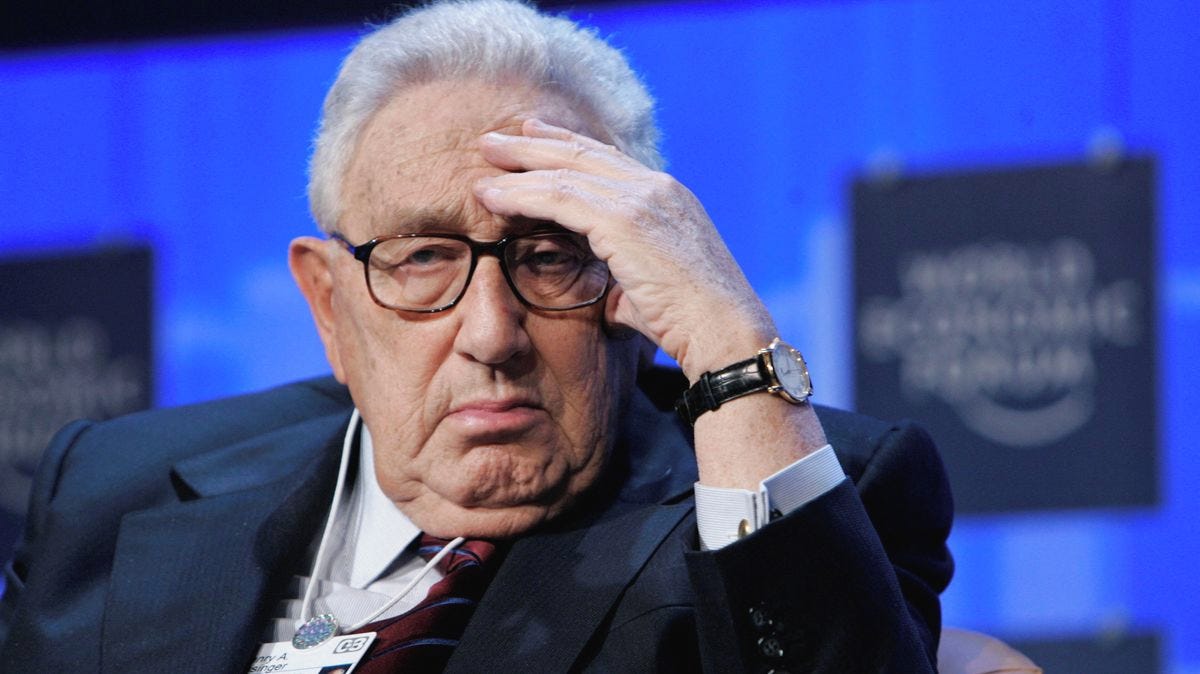
In his 2021 book The Age of AI, written with Eric Schmidt and Daniel Huttenlocher, Kissinger made a claim that should have stopped every parliament on earth. He argued that AI is not a tool like the printing press or the steam engine. It is a new form of consciousness—one that does not think like a human, does not reason like a human, and crucially, does not share our commitment to truth. He warned that when machines mediate our perception of reality, they do not simply inform us. They constitute our reality. The machine does not lie—it does not need to. It simply presents a version of events so seamless, so personalized, that the very idea of a shared fact becomes obsolete.
Kissinger was not a technologist. He was a historian of diplomacy. He knew that every stable society, from the Congress of Vienna to the Cold War, rested on a common baseline of what was true. Not absolute truth—he was too cynical for that—but a negotiated, imperfect consensus. When that baseline dissolves, politics becomes war by other means. And war, as he knew intimately, has a logic that consumes everything.
The Algorithmic Babel
Look at your phone. Look at the feed. Now look at your neighbor’s phone. You are living in different countries. Not metaphorically—structurally. The algorithm that feeds you news about the border crisis is not the same algorithm that feeds your cousin in Phoenix. You see footage of children in holding facilities. They see footage of a caravan “invading.” Both of you are angry. Both of you are righteous. Both of you are wrong—not because the facts are wrong, but because you are not seeing the same facts at all.
This is not a bug. It is the business model.

Every major platform—Meta, Google, TikTok, X—operates on a simple premise: engagement is profit. Truth is expensive. Lies are cheap and viral. The machine has learned that the most reliable way to hold your attention is to tell you what you already believe, and then tell you that anyone who disagrees is either stupid or evil. This is not a conspiracy. It is an optimization problem. And the optimum, mathematically, is a fragmented public sphere where each citizen lives in a custom-built hallucination.
