


Your phone buzzes at 9:14 p.m. The message begins with your first name, a period, an exclamation point: “Sarah! The deadline is TONIGHT and we are $4,000 short.” Below it, a photo of a tired-looking candidate, sleeves rolled, standing in front of a crowd that is not visible in the frame but is implied by the angle. A countdown clock ticks in red. A button reads DOUBLE MY IMPACT.
You have never met this candidate. You do not know if $4,000 is a real number or a number generated to feel real. You do not know if the deadline exists. But something in your chest tightens anyway, because the message was built — line by line, by a consultant who has read the split-test data on forty thousand identical messages — to make you feel that it does.
Forty minutes later, an ad interrupts your video: a woman crying, a chyron reading “SHE LOST EVERYTHING,” a narrator’s voice low and grave, and then, abruptly, a bar chart showing a 340% return on a supplement. The tears soften you. The chart persuades you it’s science. The narrator’s authority — is he a doctor? He never quite says — closes the loop.
You have just been worked over by a 2,400-year-old machine, and you didn’t recognize it because no one ever taught you its schematics.
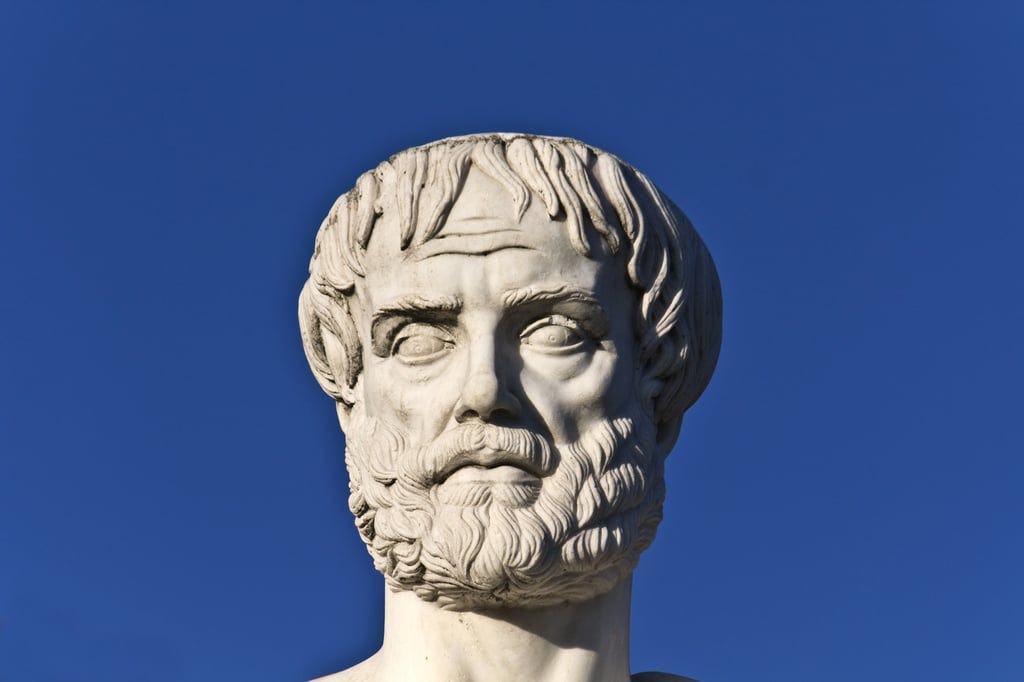
That machine has a name. Aristotle called it rhetoric, and he wrote the manual.
The Philosopher Who Reverse-Engineered Persuasion
Aristotle did something almost nobody had done before him: he refused to treat persuasion as either magic or sin, and instead dissected it like a biologist dissects a body. In his treatise Rhetoric, he identified exactly three levers by which any speaker moves any audience.
Ethos is the appeal of character — we believe people we trust, so a persuader’s first move is always to establish that they are credible, competent, or simply one of us.
Pathos is the appeal of emotion — fear, anger, hope, grief, pride. Aristotle noted, with the coldness of a man taking notes at an autopsy, that people do not judge the same way when they are friendly and calm as when they are hostile and afraid.
Logos is the appeal of logic — facts, numbers, syllogisms, the appearance of reason itself.
Here is the part almost nobody remembers correctly: Aristotle was not writing a celebration of noble persuasion. He was writing a warning wrapped as a textbook. He observed that most audiences are moved by ethos and pathos far more than by logos, not because people are stupid, but because humans decide first and rationalize second — logic is usually the ribbon we tie around a decision emotion already made. He wrote Rhetoric precisely because he saw that anyone who mastered these three levers could move a crowd toward truth — or away from it — with equal ease, and that most citizens of Athens had no idea they were being moved at all.
That asymmetry — between the few who understand the levers and the many who only feel their pull — is the entire prophecy. It has not aged. It has scaled.

The Three Levers, Now Running at Machine Speed
Walk through any modern institution built on persuasion and you will find Aristotle’s triad, simply industrialized.
Cable news exists almost entirely on pathos. The chyron is not there to inform; it is there to activate the amygdala before the segment even begins. A five-word chyron in red letters is a pathos appeal with a production budget.
