

How CBS Killed the Jester and Nobody Burned the Throne
The Silence That Cost Nothing:

On the corporate erasure of dissent, the price of a merger, and the ancient art of punishing the fool who dared speak truth to power.
Thursday night. Paul McCartney played “Hello, Goodbye” on a CBS stage in New York. Confetti. Applause. Eleven years of late-night television folded neatly into a curtain call. Stephen Colbert smiled, thanked his crew, and disappeared — not into retirement, not into creative freedom, but into the precise kind of silence that power has always preferred.
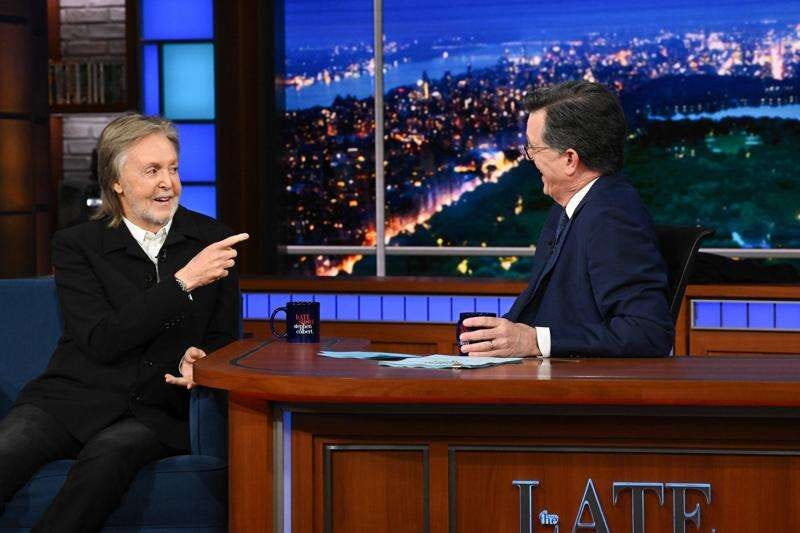
What happened was not a cancellation. Do not let them call it a cancellation. Cancellations happen to bad shows, failing shows, irrelevant shows. The Late Show with Stephen Colbert was none of these things. It was winning its timeslot. It was Emmy-nominated — for the sixth time. Its ratings were growing in a year when every other late-night program was bleeding viewers. CBS executives stood at a podium and called this a “purely financial decision” and they did so with straight faces, which is its own kind of remarkable performance art.
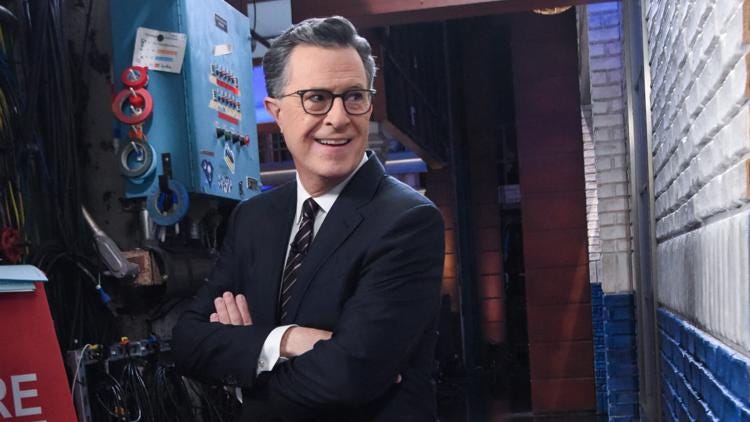
When a corporation silences its most-watched critic immediately after paying $16 million to the critic’s enemy, and then receives government approval for a billion-dollar merger one week later, you are not watching a business decision. You are watching a transaction.
The Jester Was Always Necessary
There is a reason every serious civilization has had a jester. The medieval court fool was not entertainment. He was the only figure permitted — structurally permitted — to say true things to power. His motley was a kind of armor, his absurdity a legal shield. Shakespeare understood this. Lear’s Fool is the most rational character in the entire play. When the fool disappears, in Act III, Lear is alone with the storm and his own catastrophic delusions.
Colbert was not a fool in the diminutive sense. He was the inheritor of a long tradition — from Jonathan Swift to H.L. Mencken to Jon Stewart — of using comedy as the delivery mechanism for truths that straight journalism has been too frightened, too compromised, or too deferential to speak plainly. His weapon was ridicule, which Hannah Arendt would recognize as one of the few tools that genuinely punctures the pretensions of authoritarian theatre. You cannot imprison a laugh. You can, however, buy the venue and simply not renew the lease.
The conventional wisdom — and I want you to hear this clearly because I am about to take it apart — is that this is how capitalism works. Shows get cancelled. Networks make decisions. Business is business. This is the story Paramount Global wants you to accept, and a nauseating portion of the commentariat has already internalized it. The logic goes: no conspiracy here, just cold economics, move along.
But the Numbers Don’t Lie, and Neither Does the Timeline
Here is what actually happened, stripped of the euphemism. Paramount is seeking approval for not one but two mega-mergers — with Skydance, and now with Warner Bros. Discovery — that would hand enormous consolidated media power to the Ellison family, longtime financial supporters of the sitting president. CBS, Paramount’s subsidiary, settled a lawsuit brought by that same president for $16 million, a lawsuit that virtually every legal expert described as without merit. Colbert himself called it, with characteristic precision, a “big fat bribe.” One week after the settlement. One week. The administration approved the Skydance merger.
The mechanism of censorship has been perfected: no editor needs to make a phone call, no official needs to issue a directive. The market does it. The merger does it. The regulatory approval held in reserve like a loaded gun does it — and everyone can claim clean hands.
Václav Havel, writing from inside the Czechoslovak system, described a phenomenon he called “living within the lie.” The genius of late totalitarianism, he argued, is that it does not require people to believe the propaganda — only to perform it. The CBS executive does not need to believe there were financial reasons for the cancellation. He only needs to say so. Colbert’s replacement does not need to believe the new show is better. The viewer does not need to believe the show was cancelled fairly. Everyone performs the agreed fiction, and the mechanism grinds forward.
What makes this American, what makes this 2026, is the refinement of the mechanism. The state does not shut down the press. It simply makes holding a broadcast license, or approving a merger, or granting a regulatory waiver contingent — tacitly, plausibly-deniably — on a certain editorial temperament. The FCC Chair does not need to ban Colbert. He only needs to gloat, publicly, about what happens to critics. The gloating is the message. The gloating is the policy.
The Synthesis: This Is Not a Colbert Story
I want to be honest with you about something. My impulse, reading the coverage this week, was to feel sympathy for Colbert and outrage at CBS. Both are appropriate. But they are also exactly the emotional responses that keep this story small — a story about a television host, a corporation, a political grievance. That frame is a trap.
The story is not about Stephen Colbert. Colbert will be fine. Wealthy men with platforms generally are. The story is about what happens to the architecture of public discourse when the economic structures that host speech are disciplined into compliance. It is about what Aleksandr Solzhenitsyn understood from the inside of the Gulag — that the most effective censorship is the kind that does not announce itself, the kind that works through fear, self-preservation, and the rational calculation that silence is cheaper than consequence.

PBS no longer receives federal money. NPR no longer receives federal money. The Late Show is gone. These are not three separate stories. They are one story told in three chapters, and we do not yet know how many chapters it has.
The question is not whether you liked Colbert’s jokes. The question is whether you can name, right now, who is left on network television willing to say the things he said — and whether their network has any mergers pending.
What do you do with this? I refuse to end on the usual impotent counsel — “subscribe to independent media,” “support journalism,” the ritualistic absolutions we offer each other to avoid feeling implicated. You are already implicated. So am I. We built an information ecosystem where the most critical speech in the country was being delivered by a comedian on a corporate network that needed a government stamp of approval to become slightly richer. That was always a fragile architecture. We just didn’t look at it directly.
Look at it directly now. The fool is gone. Lear is in the storm. And the question the storm always eventually forces is not what you watched, but what you were willing to say when no one with a budget was willing to say it for you.
The Late Show didn’t die. It was purchased into silence, and we called it a curtain call.