

How AI Is Sorting Us Into Winners and Losers Before We Even Notice
The Machine You Live Inside:

You open your email. There is a message from a recruiter: We regret to inform you that your application has not been selected. You check LinkedIn—a former classmate with a weaker resume just landed the role. You refresh your feed. An ad for a “career accelerator” appears. You scroll past. Later, your credit card application is denied. Your insurance premium quietly rises. Your child’s school district recommends a different track. None of these decisions were made by a person. They were made by a machine—a probability engine trained on millions of data points that you never consented to generate. And the machine has already sorted you.
This is not a dystopian fantasy. This is the infrastructure of daily life in 2025. Algorithms do not merely recommend products or predict traffic. They allocate opportunity, risk, and worth. They decide who gets the loan, who gets the interview, who gets the bail hearing, who gets flagged for surveillance. They operate silently, invisibly, without appeal. And they do not need to be malevolent to be devastating. They only need to be efficient.
You are being sorted into a box you did not choose, by a logic you cannot see, long before you ever raise your hand to object.
This is the machine you live inside. And the philosopher who understood why it would crush us—before the first computer was even switched on—was a French sociologist who died in 1917.
Durkheim’s Ghost in the Machine
Émile Durkheim is often taught as a functionalist, a dry academic who talked about suicide rates and social bonds. But the real Durkheim was a diagnostician of a disease he called anomie—a condition of normlessness, of moral confusion, of the individual cut loose from the social fabric that once gave life meaning. He saw this disease emerging from a specific cause: the division of labor.
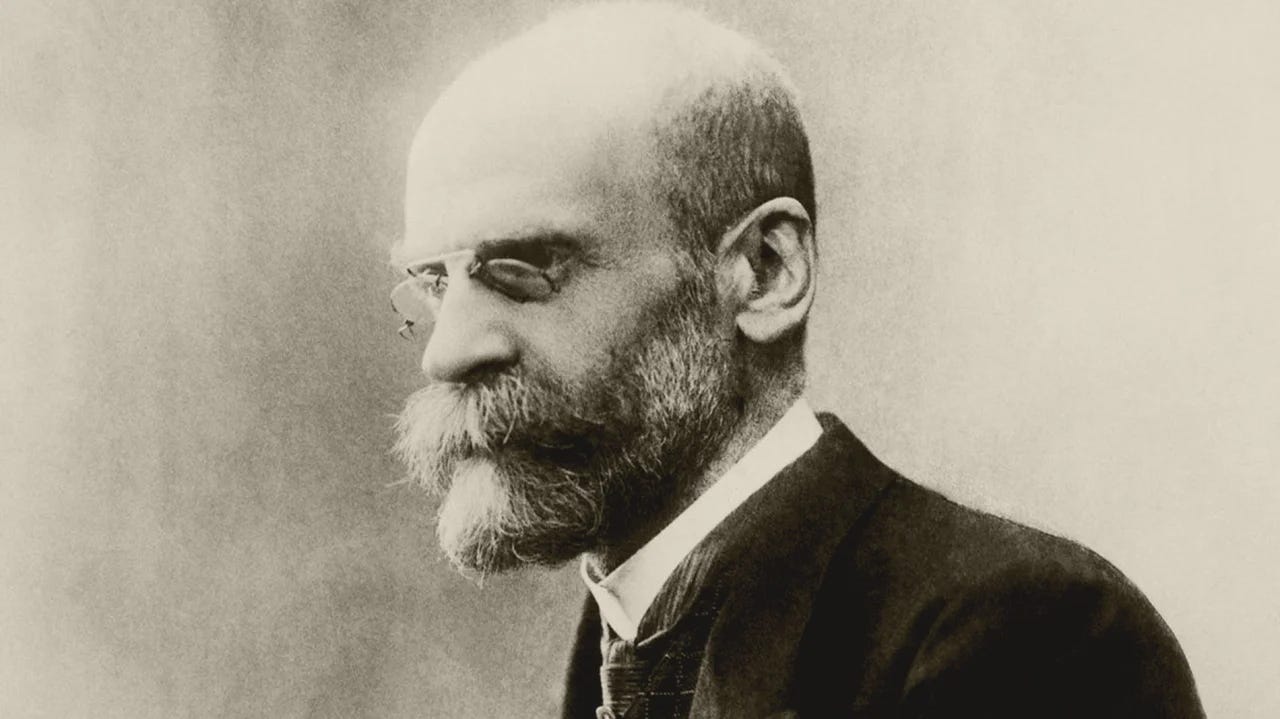
In traditional societies, people knew their place. Not in a repressive, feudal sense—but in a meaningful sense. The blacksmith, the farmer, the priest: each role was visible, stable, and woven into a web of mutual recognition. People understood how they fit. They could see the value of their work reflected in the eyes of their neighbors. There was, in Durkheim’s phrase, a collective consciousness—a shared set of beliefs and sentiments that bound individuals together.
But as societies modernized, work became fragmented. The division of labor grew dizzyingly complex. People stopped making things and started performing tiny, interchangeable functions inside giant bureaucracies. The older solidarity of likeness (mechanical solidarity) gave way to a new solidarity of interdependence (organic solidarity). In theory, this interdependence could hold society together. In practice, Durkheim warned, it often didn’t.
“The division of labor,” he wrote, “does not produce solidarity because the institutions that should create it either do not exist or are in a state of crisis.”
He foresaw that when work becomes abstract, impersonal, and rapidly shifting, individuals lose their moral bearings. They become disconnected from any larger purpose. They fall into anomie—a condition of restless, unsatisfied striving. They chase promotions, consumer goods, status—but nothing sticks. The old rules are gone. New rules haven’t crystallized. People become anxious, lonely, desperate. Durkheim linked this directly to rising suicide rates. But the deeper damage is invisible: the slow erosion of the belief that one’s life has a place in a shared world.
Now consider the machine. Not the assembly line of Durkheim’s era—but the algorithmic system that sorts, scores, and slots human beings into roles they cannot see, based on correlations they cannot challenge. This is the division of labor on steroids, stripped of any pretense of solidarity. It is not merely fragmenting work. It is fragmenting the very possibility of recognition.
The Algorithmic Division of Labor
Today’s division of labor is no longer organized primarily by industry, geography, or even profession. It is organized by data. The machine reads your browsing history, your test scores, your social media activity, your zip code, your parents’ education, your credit utilization, your keystroke dynamics during a typing test, your facial expression during a video interview. It assigns you a score. That score determines whether you are seen or unseen.
A few examples, all real:
Hiring algorithms at major corporations like Amazon, Unilever, and Goldman Sachs screen applicants using AI. They claim to find “talent.” In practice, they often reproduce the biases of past hiring data—but with greater speed and less accountability. In 2018, Amazon scrapped an AI recruiting tool that penalized resumes containing the word “women’s.” But that was the visible failure. The invisible success is the algorithm that quietly filters out candidates from non-elite universities, or those whose language patterns don’t match the dominant class.
Credit scoring algorithms now incorporate social media data, phone usage patterns, and even the type of browser you use. Lenders say this improves “prediction.” What it really does is widen the gap between the data-rich and the data-poor—and between those whose data signals “stable” and those whose signals indicate “risk,” often along lines of race, class, and geography.
In criminal justice, predictive algorithms like COMPAS assign a “risk score” to defendants. A widely cited ProPublica investigation found that these algorithms are roughly twice as likely to falsely flag Black defendants as high-risk compared to white defendants. The machine doesn’t “see” race. It sees correlation. But the outcome is the same.
In education, AI systems track student behavior, predict dropout risk, and recommend academic tracks. A student who clicks slowly, submits assignments late, or has a low number of “engagement events” may be funneled into remedial pathways before ever receiving a human assessment.
The machine does not judge your soul. It judges your statistical profile. And it does so with a speed and opacity that makes the old bureaucratic division of labor look like a slow, personal, and potentially just system.
Durkheim’s warning was that the division of labor could become forced—that people could end up in roles that did not match their talents or aspirations, simply because the system assigned them there. He called this “the forced division of labor.” What we have now is a hidden forced division of labor, enforced not by law or custom but by algorithm. You don’t know why you were rejected. You don’t know what signal triggered the filter. You just know you didn’t make the cut. Over time, you internalize the judgment. You stop applying. You lower your expectations. You shuffle into whatever slot the machine left open.
This is anomie upgraded. It is the ultimate privatization of worth.

Why This Pattern Is Inevitable
If you think this is a bug that can be fixed with better ethics training or a few more diverse data scientists, you misunderstand the machine. This pattern is not accidental. It is structural.
Three forces make it inevitable:
1. The logic of efficiency. In a competitive market, any organization that can reduce labor costs, increase speed, and optimize outcomes will do so. If an AI can screen 10,000 resumes in a second and produce a shortlist that correlates moderately well with future performance, why would a company pay humans to do it? The argument that AI is “less biased” is often a cover for the argument that it is cheaper. Efficiency is a god that demands sacrifice. The sacrifice is fairness, transparency, and the human ability to tell a story about oneself.
2. The asymmetry of data. The machine knows infinitely more about you than you know about it. You cannot see your score. You cannot contest the correlation. You cannot demand an explanation for why a certain phrase in your cover letter triggered a rejection. The data is owned by the platforms and the employers. They have no incentive to give you full access. Transparency threatens their power. As legal scholar Frank Pasquale noted, we live in a “black box society.” The machine sorts you; you remain in the dark.
3. The erosion of countervailing institutions. In Durkheim’s vision, the division of labor could be managed by intermediate groups—unions, professional associations, local communities—that re-embedded individuals in a web of meaning and mutual recognition. These groups have been systematically weakened over the past fifty years. Unions are a shadow of their former selves. Professional guilds have been deregulated. Communities have atomized. There is no institution left that can represent your interests to the algorithm. You face the machine alone.
This is why the pattern will deepen, not recede. As AI becomes more sophisticated, it will sort more aspects of life: who gets health insurance, who gets a mortgage, who gets admission to university, who gets flagged for welfare fraud, who gets a speeding ticket, who gets a job interview. The categories will be ever finer. The decisions will be ever faster. The human sense of agency will continue to erode.
The inevitability is not technological. It is political. We have allowed the machine to be built without guardrails. We have outsourced moral judgment to statistical optimization. We have confused correlation with meaning.
What You Lose When You Don’t Even Notice
The quiet damage of algorithmic sorting is not that it is unfair—though it is deeply unfair. The quiet damage is that it makes unfairness invisible. In an older bureaucracy, a human manager might reject you with a plausible excuse. You could argue. You could appeal. You could at least suspect bias. There was friction. And friction, though inefficient, forces recognition. It forces the other to see you as a person, not a profile.
The machine removes friction. It removes the possibility of being seen. And without being seen, you cannot be recognized. And without recognition, there is no solidarity. And without solidarity, there is only anomie—the condition of being adrift, unknown, worthless in the eyes of the system.
The deepest stake is not economic inequality. It is the erosion of the belief that one’s life has a place in a shared world.
Durkheim understood that human beings need more than food and shelter. We need meaning. We need to feel that our labor contributes to a whole—that we matter to others. The algorithm destroys that feeling in two ways. First, it assigns you a role that may have no connection to your sense of self. Second, it tells you—through its silence, its opacity—that you are not worth explaining. You are just a data point. A probability. A risk score.
This is why the crisis is not merely about jobs or wages. It is about the very fabric of social existence. When enough people feel invisible, untethered, sorted into boxes they never consented to, the result is not just resentment. It is rage. It is withdrawal. It is the formation of parallel realities where people refuse to believe in any shared truth—because the shared truth rejected them first.
The machine you live inside is not just sorting winners and losers. It is sorting citizens into two classes: those who are visible and those who are managed. And if you think you are on the right side of the sort, ask yourself: how long until the algorithm decides otherwise?
An Exit Strategy for the Thinking Citizen
There is no simple fix. You cannot “opt out” of the algorithm—it runs on your data whether you participate or not. You cannot “regulate” your way to safety—the machine is too fast, too distributed, too entangled with capital. You cannot return to a pre-digital world—that nostalgia is a trap.
But you can do something. You can see the machine. You can name it. You can refuse to treat its judgments as natural. Every time an app tells you what to watch, what to buy, whom to date, what career to pursue, you can pause and ask: Who designed this sorting? Whose interest does it serve? What vision of the human does it assume?
This is not Luddism. This is the beginning of politics.
The first act of resistance to the machine is to refuse to be sorted without knowing the criteria. The second is to demand that the criteria be made public. The third is to build new institutions—unions of the data class, cooperatives of the algorithmically sorted—that can speak back to the system.
Durkheim believed that anomie could only be overcome by strengthening the intermediate groups that connect individuals to society. The same holds today. We need new guilds, new associations, new forms of collective voice that can stand between the individual and the algorithm. We need a politics of algorithmic transparency, data dignity, and institutional renewal.
The machine will not disappear. But it can be tamed. It can be forced to justify itself. It can be embedded in a social order that values recognition over efficiency.
To live inside the machine is not to be crushed by it. It is to learn its language, understand its limits, and demand that it serve us—not the other way around. That struggle begins with a single act of awareness: seeing the cage for what it is.
You are being sorted. But you are not yet defined.