


The man on the screen is furious. He is filming himself in a car, or a hotel bathroom, or a sterile home office with a bookshelf behind him that suggests he reads. His jaw is tight. His voice cracks with something that sounds like moral outrage but smells like performance. He is explaining, for the 47th time this month, that the people who want to destroy Western civilization are the ones who think pronouns matter. He has 2.3 million followers. He sells a course on masculinity. He calls himself a “truth-teller.” And when you watch him long enough—past the clickbait thumbnail, past the algorithmic rage-bait, past the carefully curated “I’m just asking questions” posture—you realize something is missing. He is not arguing with anyone. He is not trying to persuade. He is not even trying to win. He is trying to be seen as the one who is winning.
This is not politics. This is a metaphysical crisis dressed up in Patagonia vests and sponsored by a magnesium supplement company.
The “anti-woke” influencer industrial complex has been analyzed to death by journalists who treat it as a media phenomenon, a political strategy, or a psychological pathology. But none of those frameworks reach the bone. To understand why a grown man will spend 14 hours a day screaming into a microphone about whether drag queens belong at story hour, you need a philosopher who died in 1831, whose most famous book is almost unreadable, and who understood something about human consciousness that the algorithms have accidentally weaponized.
You need G.W.F. Hegel. And you need to understand what he actually meant by the “master-slave dialectic”—because it is not what you think it is, and it is happening right now, in real time, every time you scroll.
The Man Who Saw the Fight Before the Fight
Hegel was not an easy man. He wrote sentences that loop back on themselves like snakes eating their own tails. He was a German idealist who believed that history was the story of Spirit (or Geist) coming to know itself through conflict. But buried inside his 1807 masterpiece, The Phenomenology of Spirit, is a short, brutal passage that has haunted Western thought for two centuries. It is called the master-slave dialectic, and it is not about literal slavery. It is about what happens when two human beings meet for the first time and realize that they both want the same thing: recognition.
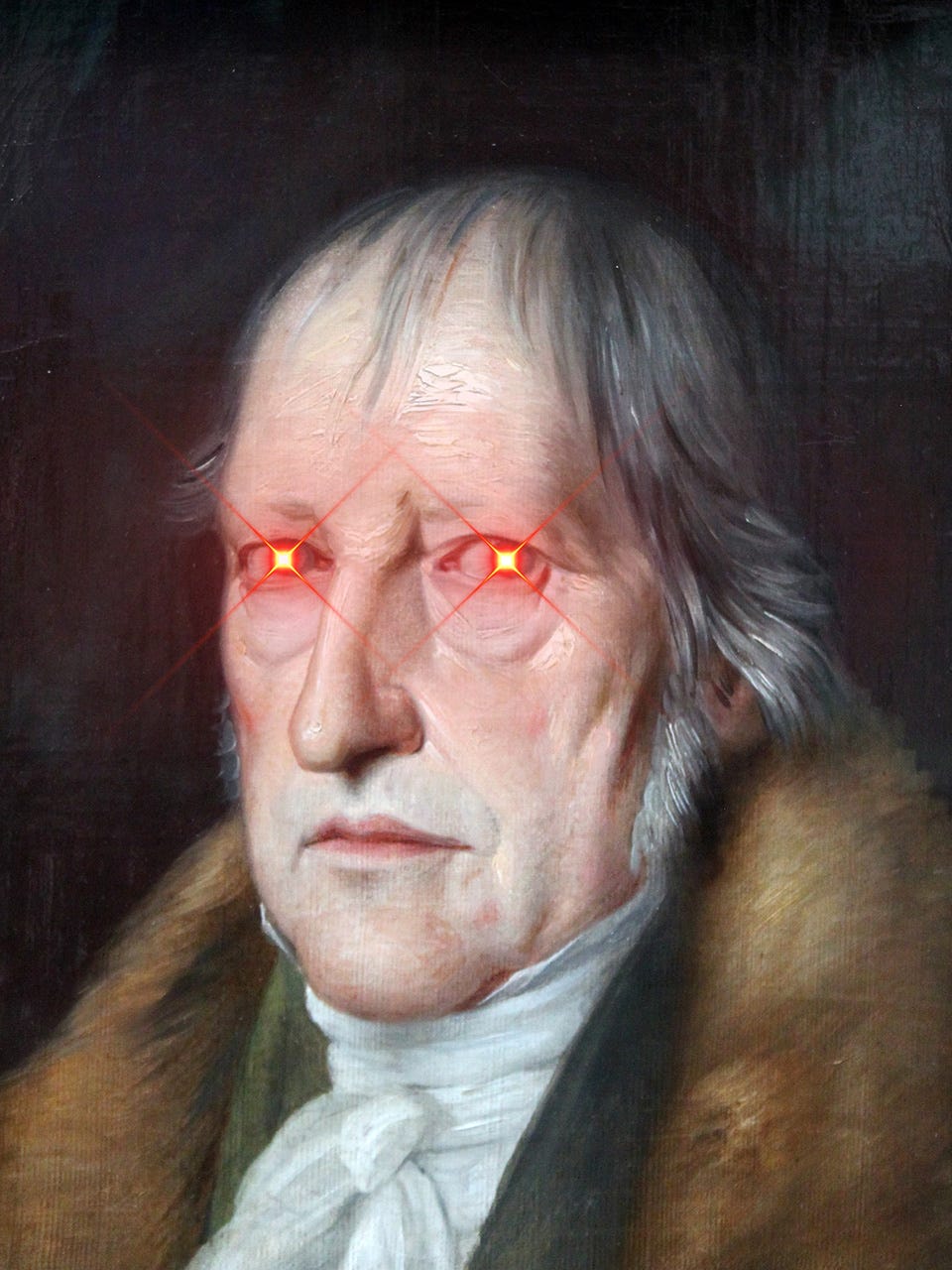
Here is the core insight, stripped of the jargon. Imagine two people meet. Each one wants the other to acknowledge their existence, their value, their reality. But there is a problem. Recognition only means something if it comes from someone you respect. If you can force someone to bow to you, you get their submission—but you do not get their genuine recognition. You get a puppet. And a puppet cannot give you what you actually need.
Hegel saw that the fundamental human drive is not survival, not wealth, not power—it is the desperate, aching need to be seen as real by another consciousness. And he saw the trap. The person who wins the fight for dominance becomes the master, but the master is actually the loser. Because the master is now dependent on a slave whose recognition is worthless. The slave, meanwhile, is forced to work on the material world, to transform it, to build things, to create. And through that labor, the slave develops self-consciousness, skill, and a genuine sense of self that does not depend on anyone’s permission.
The master is stuck. The master can never be free, because the master’s entire identity depends on someone else’s subordination. The master cannot grow. The master cannot learn. The master is frozen in a posture of dominance that is actually a prison.
Now look at the man on the screen.
The Algorithmic Master
The anti-woke influencer is not a political operative. He is not a cultural critic. He is not a philosopher. He is Hegel’s master, trapped in a digital hall of mirrors, screaming for recognition from people whose recognition he has already rendered worthless.
Watch the pattern. The influencer selects a target—a university administrator, a corporate DEI officer, a trans activist, a liberal journalist. He frames the target as absurd, hypocritical, or dangerous. He performs outrage. His audience responds with validation. He escalates. The target responds—or does not. Either way, the influencer wins. But look closer. What is he actually doing? He is constructing a world in which he is the master and everyone else is the slave. He is the one who names reality. He is the one who decides what is “woke” and what is “based.” He is the one who sits in judgment.
But here is the Hegelian poison. The people he is dominating—the “woke mob,” the “cancel culture,” the “radical left”—are not real to him as human beings. They are props. They are rhetorical punching bags. He does not want their genuine recognition because he has already decided they are beneath him. He wants their submission. And he gets it, in the form of angry replies, platform bans, and the occasional media hit piece that only grows his audience.
He is the master who has won the fight, and he is the most miserable person in the room.
Because the recognition he craves can only come from equals. And he has systematically eliminated everyone he considers an equal. His audience is not his peer; his audience is his mirror. They agree with him. They amplify him. They send him money. But they cannot give him what he actually needs: the acknowledgment of someone who could have said no and chose to say yes. The slave’s recognition is worthless because the slave is not free. And the influencer’s audience is not free. They are algorithmically herded, emotionally manipulated, and structurally dependent on his performance for their own sense of identity. They are not giving him recognition. They are giving him a fix.
This is not an accident. This is the structural logic of the platform economy.
The Architecture of Dependence
Why does this pattern feel inevitable? Because the economic incentives and the psychological vulnerabilities align perfectly.
The platforms—YouTube, Twitter, TikTok, Substack itself—are not in the business of truth. They are in the business of attention. And nothing captures attention like a fight. But not just any fight. A fight that can never end. A fight that must be re-staged every day because the master’s identity is fragile. The master needs a new slave to dominate every morning, or else the master wakes up and realizes he is nothing.
The structural force at work is what Hegel called the “unhappy consciousness”—the condition of being split against yourself, needing something you cannot have, and turning that need into a permanent war.
The anti-woke influencer is the unhappy consciousness made flesh. He needs recognition from a world he has already condemned. He needs to be taken seriously by people he has already dismissed. He needs to win a game that has no finish line. And the platform rewards him for staying in this state. Every video, every tweet, every podcast appearance is a new bid for the recognition that cannot come. The algorithm does not care about his soul. It cares about his engagement metrics. And those metrics go up the more he performs the master’s role.
This is why the content is so repetitive. The targets change—a new pronoun guide, a new diversity training, a new academic paper—but the structure is identical. The influencer identifies a threat to his dominance, performs righteous anger, and demands submission. The audience responds with the only currency they have: attention. And the influencer is trapped.
He cannot stop. If he stops, he has to face the silence. He has to face the question: who am I when no one is watching? And that is a question the master cannot answer, because the master’s identity is entirely external. It is a reflection in the eyes of people he has already defeated.
The Real Cost of Winning
What happens if we do not understand this? What happens if we keep treating the anti-woke influencer as a political problem to be debated, rather than a metaphysical condition to be diagnosed?
We lose. Not because the influencers will win—they are already losing, they just do not know it yet—but because we will mistake the symptom for the disease. We will argue about free speech when the real issue is the structure of recognition. We will debate cancel culture when the real issue is the architecture of dependence. We will try to fact-check people who are not making factual claims but existential ones.
The cost of ignorance is that we become participants in the master’s game. Every time we engage, every time we share a clip with the caption “look at this clown,” every time we give the influencer the fight he needs, we are playing the slave. We are giving him the recognition he craves. We are confirming that his performance matters. We are the ones who keep the master in power, because we refuse to see that his power is a hallucination.
And the cost goes deeper. The anti-woke influencer is not just a media nuisance. He is a symptom of a society that has forgotten how to give and receive genuine recognition. We have outsourced our sense of worth to platforms that are structurally incapable of providing it. We have confused visibility with value. We have mistaken being seen for being known. And the influencer is just the most extreme version of a condition that affects all of us.
The master is not the enemy. The master is the warning.
The Posture of the Thinking Citizen
There is no solution to the master-slave dialectic. Hegel did not offer one. He described a process that history must work through, a struggle that consciousness must endure. The slave becomes free through labor, through transforming the world, through developing a self that does not depend on the master’s approval. But that is a long process, and it is not a technique you can apply.
What the thinking citizen can do is refuse the frame.
The posture is not to argue with the influencer. It is not to fact-check him. It is not to expose him. It is to recognize that he is in a prison of his own making, and that the only way out is for him to see the bars. You cannot show him the bars. He will not believe you. But you can stop pretending that his cage is a throne.
The thinking citizen does not give the master what he wants: the fight, the recognition, the confirmation that his war matters. The thinking citizen turns away. Not in contempt. Not in dismissal. But in the quiet recognition that the master is not the one who decides what is real.
The labor of genuine self-making happens elsewhere. It happens in the work that transforms the material world—the writing, the building, the teaching, the care. It happens in relationships of mutual recognition, where two free people choose to see each other. It happens in the slow, unglamorous work of becoming a person who does not need to dominate to feel real.
The influencer will not save you. The platform will not save you. The algorithm does not care about your soul.
The question is not how to defeat the anti-woke influencer. The question is: what are you building with your hands while he screams into the void?
The full framework for navigating the recognition economy—including Hegel’s three principles that surviving citizens have always used to avoid the master’s trap—is available to paid subscribers below.
