

Baudrillard’s Haunting Prophecy: Why Trump’s Flying Palace Is the Perfect Symbol of Our Age?

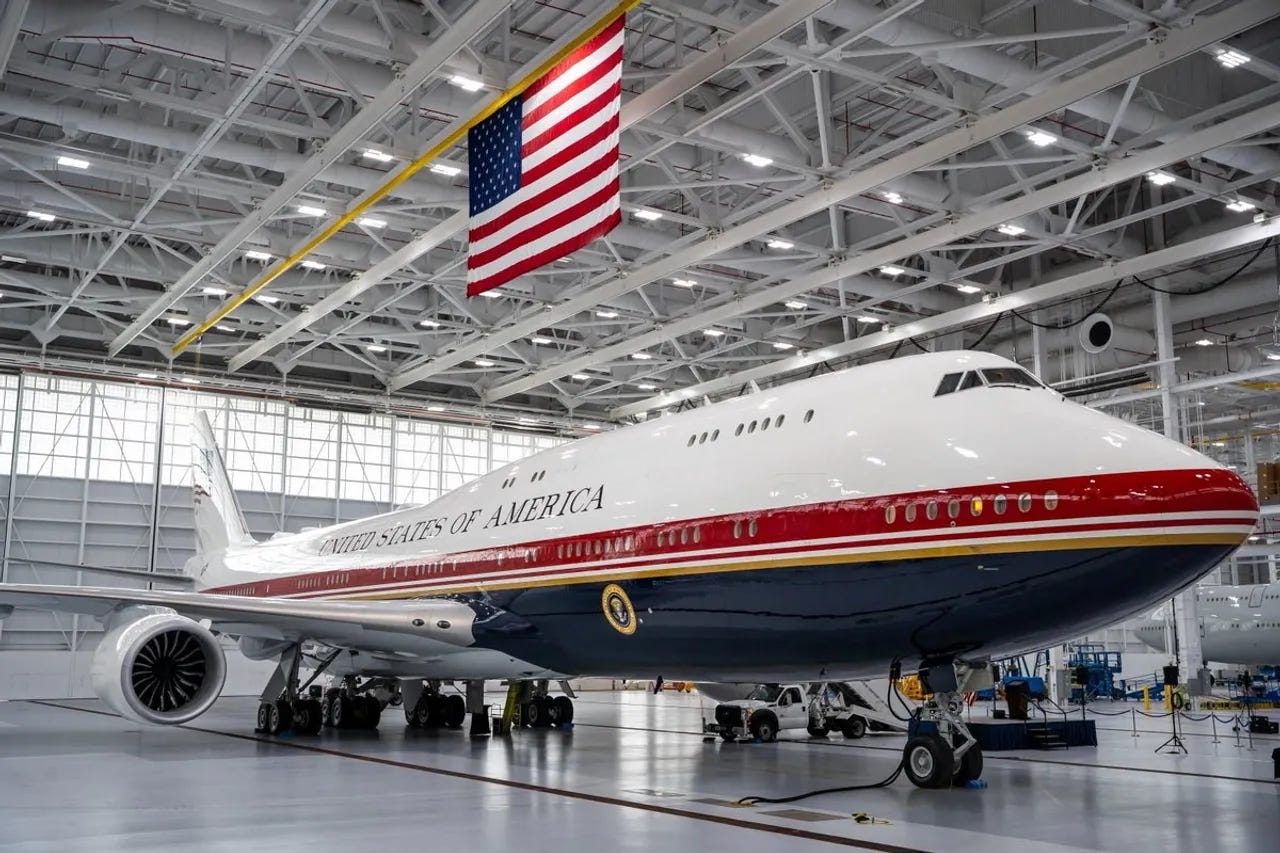
You are standing on the tarmac at LaGuardia, and there it is: a Boeing 757, painted in dark blue and gold, with the name “TRUMP” emblazoned in letters large enough to read from a mile away. The tail fin bears the family crest—a lion rampant, an eagle, and a motto in Latin you cannot quite parse. But the absurdity isn’t in the heraldry. It’s in the interior: gold-plated seatbelt buckles, sinks carved from a single slab of onyx, a master bedroom with a 24-karat gold sink, and a 48-inch television that no one watches because the real show is the plane itself. This is not a means of transportation. It is a mobile throne, a flying temple to a man who has never needed to fly commercial. And yet, as you watch it taxi toward the terminal, you realize something deeper: this plane is not a symbol of power. It is a symbol of the absence of power—a shimmering facade that has replaced any reality beneath it. Jean Baudrillard, who died in 2007, saw this coming with terrifying clarity. Welcome to the hyperreal.
The Thinker
Jean Baudrillard was a French sociologist and philosopher who spent the second half of the 20th century warning that the West was losing its grip on reality. He was not a dry academic; he was a provocateur, a man who wrote The Gulf War Did Not Take Place while the bombs were falling. His central idea was that we had entered an age of “simulacra”—copies of things that no longer have originals. He argued that we are drowning in signs that refer only to other signs, creating a world where the map precedes the territory. Think of a Disneyland version of Main Street USA that looks more “American” than any real Main Street, and then realize that the real Main Street has now been renovated to look like the Disney version. That is hyperreality.
For Baudrillard, the process was inexorable. First, the image reflects a basic reality. Then it masks and perverts that reality. Then it masks the absence of a basic reality. Finally, it bears no relation to any reality whatsoever—it is its own pure simulacrum. He called this the “precession of simulacra,” and he believed it was the defining condition of the late 20th and early 21st centuries. He did not write about politics in the usual sense; he wrote about how politics itself had become a simulation, a series of spectacles designed to create the illusion of choice while all real decisions were made elsewhere. Trump’s flying palace is not a tangent from Baudrillard’s thought—it is the culmination.
The Prophecy
Now map Baudrillard’s warning onto the present. In 2015, when Donald Trump descended that golden escalator in Trump Tower to announce his candidacy, he was not entering politics. He was entering a simulation of politics that had been prepared for him by decades of reality television, celebrity culture, and media fragmentation. His campaign rallies were not political events—they were live performances, scripted in their improvisation, designed to generate viral moments. His presidency was not a governing project; it was a reality show called The Apprentice meets House of Cards, with a cast of characters who served more as archetypes than as actual human beings.
And at the center of it all was the plane. The Boeing 757—often called “Trump Force One”—is not just a luxury vehicle; it is a perfect simulacrum of presidential power. It mimics Air Force One in scale and grandeur, but it is a private jet that Trump owned before he ran for office. It is a symbol that refers not to the actual power of the presidency (which he would later hold) but to the idea of power—a pre-owned corporate jet dressed up in the costumes of monarchy. When Trump used it to fly to campaign rallies, he was not traveling; he was creating a moving backdrop. The plane became a stage prop, and the airports became soundstages.
Baudrillard predicted that in the age of hyperreality, the “real” would be replaced by the “hyperreal”—a version of reality that is more vivid, more dramatic, and more satisfying than the messy, ambiguous, and inconvenient real world. Trump’s flying palace is hyperreal: it is more “presidential” than any actual president’s plane, because it has no functional constraints. It does not need to coordinate with the Secret Service or the Air Force; it exists purely as a sign. And we, as spectators, have become so accustomed to this simulation that we no longer ask what the plane means—only whether it looks good on Instagram.
The Mechanism
Why is this happening? Why has the flying palace become the perfect symbol of our age? The mechanism is twofold, and both parts are structural rather than personal. First, the media environment of the late 20th century created a “society of the spectacle” where images became the primary currency. Guy Debord, a contemporary of Baudrillard, wrote about this in the 1960s, but Baudrillard took it further: he argued that the spectacle had not only commodified images but had eliminated any possibility of a reality outside the image. Reality became a special effect.
Second, and more specifically, we have witnessed the collapse of shared narratives—the storylines that once held society together, like the “American Dream” or “progress through democracy.” In their absence, we have turned to personal brands and celebrity figures to provide meaning. Trump’s flying palace is not an anomaly; it is a logical endpoint of a culture that has abandoned collective truth for individual spectacle. The plane is the ultimate status symbol—but status symbols only work if everyone agrees on the symbolic value. And Baudrillard saw that in the hyperreal, such agreement is fading. The plane is simultaneously a sign of immense wealth and a sign that wealth has no meaning, because it is detached from any productive function.
The human weakness that makes this pattern inevitable is our hunger for the spectacular. We would rather watch a fake presidential plane than engage with the complex, mundane operations of actual governance. We have become addicted to the simulation because it is easier to consume than the real. The mechanism is not conspiracy; it is desire. And that desire has been systematically cultivated by a media economy that rewards attention over truth, and by a political system that has learned to mimic the rhythms of entertainment rather than the labor of deliberation.
The Stakes
If we fail to understand this, the cost is not merely aesthetic—it is existential. We are entering what Baudrillard called the “desert of the real,” a state where we can no longer tell the difference between a genuine political movement and a simulation of one, between a true crisis and a manufactured spectacle. The flying palace is a perfect symbol of this desert because it is both empty and dazzling. It draws our gaze while revealing nothing.
The stakes include the erosion of democratic accountability. If a leader’s power is measured by the spectacle of a private jet rather than by policy outcomes, then the electorate becomes an audience, not a citizenry. We no longer demand results; we demand performances. The 2020 election, the January 6th insurrection, the “Stop the Steal” movement—all were expressions of a populace that had lost its grip on shared reality, preferring instead the simulations offered by competing media ecosystems.
There is no false comfort here. The cost of ignorance is not a slow slide but a sudden rupture. We have already seen it: a nation that cannot agree on basic facts, a political class that performs governance while the real decisions are made by unelected interests, and a media industry that profits from confusion. The flying palace is not a joke; it is a tombstone for the real. Baudrillard’s warning is not that we will be fooled by the simulation, but that we will prefer it.

The Exit
What is the thinking citizen to do? Not despair, but see. The first gesture is recognition: to call the flying palace what it is—a simulation. To name the hyperreality, to refuse the easy consumption of spectacle. This does not mean retreating into a naive realism, because there is no “real” outside the simulation to go back to. But it does mean cultivating a posture of critical distance. Baudrillard himself offered no solutions; he only offered diagnosis. And diagnosis is the precondition for any meaningful action.
The posture is that of the anthropologist in a foreign culture, observing the rituals of power without being seduced by them. When you see the golden sink, ask: what is this sign trying to hide? The answer is always its own emptiness. The thinking citizen does not look away from the spectacle; they look through it, tracing the lines of simulation back to the structural forces that generated it.
The question that rewards a paid subscription is this: What does it mean to resist hyperreality without falling into nihilism? Is there a way to live with the knowledge that the real is gone, without surrendering to cynicism? Baudrillard’s late work hinted at a kind of radical patience—a refusal to participate in the game of signs. But that patience requires a community of readers willing to hold the line. The full framework for navigating hyperreality—including Baudrillard’s three principles that surviving citizens have always used—is available to paid subscribers below.