

An Autopsy of Control: What the MS-13 Mega-Trial Reveals About the Sickness of the Modern State

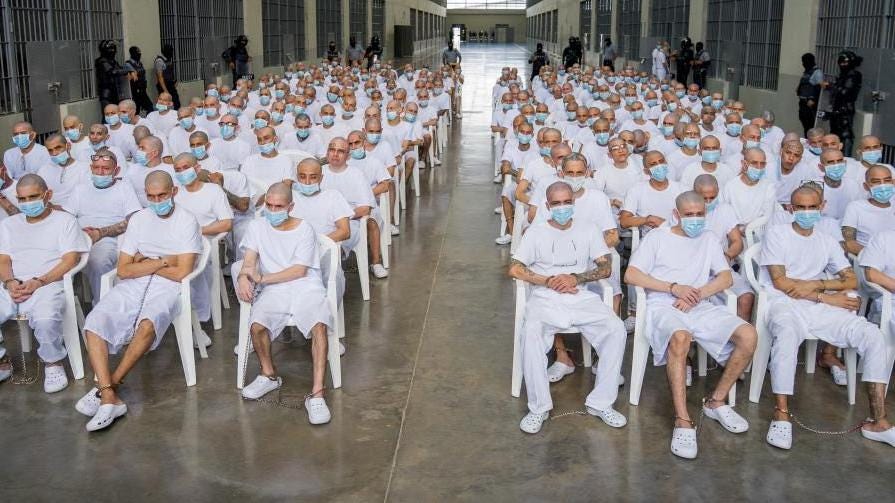
El Salvador’s trial of 486 alleged MS-13 members is not a show of strength, but a symptom of a terminal illness within the modern state. This is the clinical diagnosis of a power that has failed, the grim prognosis for societies that choose coercion over legitimacy, and the only prescription that remains.
Symptoms: The Theater of Absolute Power
Observe the scene. Nearly five hundred men, torsos covered in the hieroglyphs of gang affiliation, sit stripped to the waist in a vast, sterile courtroom. They are the centerpiece in the state’s grandest performance: the mass trial of MS-13. The charges are monumental, totaling over 47,000 alleged crimes, a number so large it becomes abstract, almost meaningless. The state presents this as a surgical strike against a societal cancer, a demonstration of its absolute and unflinching control. The media broadcasts the images globally, and a frightened populace exhales, believing order is being restored by an iron fist.
But this spectacle is not a sign of health. It is a fever dream. Like a patient exhibiting wildly exaggerated symptoms, the state’s performance masks a deep, systemic sickness. This muscular pageantry, this obsession with the optics of domination, is the most telling symptom of a body politic in the advanced stages of decay. It is the political equivalent of septic shock—a violent, system-wide overreaction to an infection that has been allowed to fester for far too long precisely because the body was too weak to fight it honestly.
Diagnosis: The Atrophy of Legitimate Sovereignty
The diagnosis is stark: the state is suffering from a catastrophic atrophy of legitimate sovereignty. A healthy state projects power quietly. Its authority is implicit in the functioning of society—in the roads that are safe to travel, the businesses that can operate without paying tribute to thugs, and the courts that dispense individualized justice. It doesn’t need a televised spectacle to prove it’s in charge; its legitimacy is self-evident. The mega-trial is a confession. It is an admission that for decades, in vast swathes of the country, the state was not the true sovereign. MS-13 was.
The gang offered a perverse mirror of the state’s functions: it collected taxes (extortion), provided a form of security (for those under its dominion), and enforced its own brutal laws. It grew in the vacuum left by a state that had abdicated its most basic responsibilities. This mass trial, therefore, is not the action of a confident power vanquishing an enemy, but the desperate act of a failed power trying to reclaim territory it had long ago ceded. It is an attempt to kill the monster that its own negligence birthed. Gangs are not a cancer on the body politic; they are a symptom of a body politic that is already rotting from within.
The Pathogen: A Manufactured Epidemic
No disease appears from nowhere. The pathogen that became MS-13 was cultivated in the petri dishes of Los Angeles prisons and then exported to Central America via decades of U.S. deportation policy. Men brutalized by American carceral culture were dropped into post-civil war societies that were economically devastated and institutionally fragile. There was no plan for them, no opportunity, no hope. They did what traumatized, abandoned men do: they organized for survival, using the violence they had learned.
The state, hollowed out by corruption and war, had no antibodies. It could neither integrate these men nor effectively police them. So the infection spread, not because the gang was invincible, but because the host body was uniquely vulnerable. The current ‘iron fist’ approach ignores this etiology completely. It treats a deep-seated, systemic infection as if it were a surface wound, believing that a large enough bandage can cover the rot beneath.
Prognosis: The Contagion of Authoritarian Cures
The prognosis is grim. While this brutal crackdown may suppress the symptoms in the short term—and the precipitous drop in the homicide rate is undeniable—the long-term side effects of the treatment are toxic. By suspending due process, relying on collective accusation, and building a carceral state of unprecedented scale, El Salvador is administering a form of political chemotherapy. It may kill the cancerous cells, but it poisons the entire system in the process.
What kind of society emerges from this? One where the distinction between the law and arbitrary power has been erased. One where the state’s methods become indistinguishable from the gang’s. The new mega-prisons will become universities of radicalization, creating a new generation of hardened criminals with a legitimate grievance against the system that discarded them. When a society celebrates the suspension of due process for its monsters, it soon finds it has suspended it for everyone. The temporary peace is bought at the cost of democratic legitimacy, and the next outbreak of the disease will be resistant to any cure short of total tyranny.
Prescription: The Unsexy Work of Rebuilding the Body
There is no magic bullet. The only prescription is the long, arduous, and politically unrewarding work of rebuilding the social organism from the cellular level up. This isn’t about grand gestures; it is about restoring the basic functions that make a state legitimate. It means creating economic pathways that offer more dignity and reward than gang life. It means community policing based on trust, not terror. It means a justice system that investigates crimes meticulously and prosecutes individuals fairly, making the spectacle of a mass trial unnecessary.
It means addressing the deep despair that makes a young man see a gang tattoo as his only path to identity and power. This cure is slow. It doesn’t produce dramatic images of tattooed men in cages. It doesn’t satisfy the public’s thirst for vengeance. But it is the only way to build a society that is genuinely immune to the pathologies of gang rule. The choice for El Salvador, and for any nation watching, is between the theatrical satisfaction of populist brutality and the difficult, generational work of building a just and functioning social contract.