

A Post-Mortem on the Alliance That Mistook Fear for Vision

Writing from 2045, we look back at the slow-motion collapse of the Quad. Its failure was not a surprise event, but a structural inevitability born from a fatal misunderstanding of power. This is the story of how an alliance built on a shared enemy unmade itself from within.
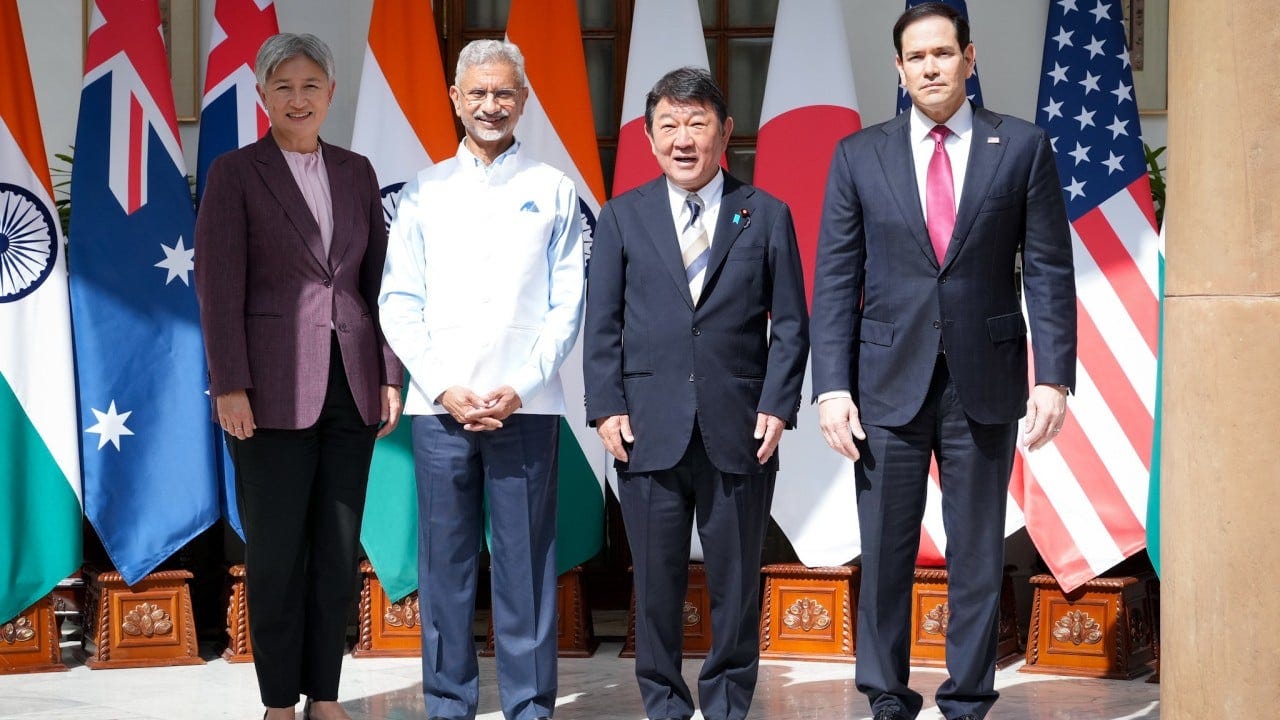
The Archives Speak (A View from 2045)
From my desk in 2045, the declassified diplomatic cables feel like relics from another civilization. The paper is brittle, the language cautiously optimistic. They document the meetings of the Quadrilateral Security Dialogue—the “Quad”—an alliance that promised to shape the 21st century. Today, of course, it is a historical footnote, a case study in our academy courses on strategic failure. Students often ask me the same question: How did an alliance of four great democracies, possessing such immense economic and military power, simply wither away?
Most popular histories blame the ‘Pacific Crisis of 2032’ or the economic decoupling that followed. But the truth, as these archives reveal, is that the terminal diagnosis was written nearly a decade earlier. It was drafted not in Beijing or on a contested battlefield, but in a quiet conference room in New Delhi in the mid-2020s. It was there, amidst handshakes and carefully worded communiqués, that the fundamental flaw in the alliance’s architecture was exposed. It wasn’t an external force that undid them. It was a poison they administered to themselves, year after year, meeting after meeting.
That poison was the comforting, seductive illusion of consensus. And the Delhi meeting was its telltale symptom.
The Hall of Mirrors
Looking back at the public statements from that era is an exercise in political archeology. The language was always impeccable: a “free and open Indo-Pacific,” a “rules-based international order,” a commitment to “shared values.” On the surface, it was a coherent front, a necessary bulwark against rising authoritarianism. This was the story they told the world, and more importantly, the story they told themselves.
The Quad, in the 2020s, was a perfect Rorschach test. Each member saw in it what they wanted to see. For Washington, it was a force multiplier for its pivot to Asia. For Tokyo, a hedge against an aggressive neighbor. For Canberra, a security guarantee in an uncertain region. For New Delhi, a tool of strategic autonomy. These are not the same thing. They are, in fact, often contradictory goals, papered over with diplomatic platitudes.
They believed that a shared threat was enough to create a shared purpose. They were wrong. The private communiqués I’m reviewing tell a very different story—one of divergence, quiet vetoes, and a deep-seated reluctance to define what they were actually for, beyond what they were against. And that is a fatal weakness for any human enterprise.
The Depth That Changes the Analysis
You’ve seen the official history. What follows is the autopsy. We now know that the alliance’s failure was pre-programmed by three fundamental flaws they refused to confront. The paid section delivers: a deconstruction of the ‘Ambiguity Trap’ that paralyzed them, the real story of the economic divergence that made military cooperation impossible, and the Tocquevillian lesson we were forced to relearn in the 2030s. If understanding how great powers fail matters to you, it’s worth the price of admission.
Become a paid subscriber to continue reading…

The Ambiguity Trap: A Feature, Not a Bug
You are now past the threshold. What follows is the diagnosis. The central mechanism of the Quad’s failure was something its architects celebrated as a strength: its strategic ambiguity. By refusing to codify itself as a formal military alliance, it gave each member plausible deniability and maximal flexibility. This was sold as a feature. In reality, it was a fatal bug.
